What's in her name?

What's in her name (Salish Aire)?

Salish
from her new home the Salish Sea

Aire as in a melody of song.

Salish + Aire = The melody of the Salish Sea.

Salish Sea:
In the late 1700's Captain George Vancouver wandered around the waters of what are now known as British Columbia, Canada and Washington State, USA. He did the usual 1700's explorer thing and put names he chose on everything he saw. The names stuck and are recognized and used to this day.

New lines were added to Captain Vancouver's charts in 1872 (after a near war with Great Britain over a pig) which made waters on one side of the line Canadian and those on the other side of the line American.

It wasn't until 1988 (officiated in 2009) that someone finally realized that fish and various critters, (to say nothing of the water itself) were never involved in the boundary treaties and really ignored them completely. (This is best illustrated by the problems that Homeland Security has with Canadian Canada Geese and American Canadian Geese - it seems they refuse to carry passports and have been known to poop on the head of any border patrol person who tries to challenge their right to cross the border when and where they choose!) In reality the waters from Olympia to the well up the East side of Vancouver Island are pretty much one ecosystem.

The Coast Salish are the indigenous peoples who live in southwest British Columbia and northwest Washington state along the Salish Sea and share a common linguistic and cultural origin. The Salish Sea is named in honor of the earliest recorded peoples who plied her waters and learned to live in harmony with her.


Monday, July 29, 2019

Vacation from the boat


July 29, 2019

I’m sitting in a friend’s house in Everett, Washington where we are house and dog sitting as we near the end of our 1 month vacation from boating.

We ended the last blog post in Puerto Penasco  where we were prepping the boat to be hauled out and stored on-the-hard while we travelled. We figured we would take care of some bottom work that could only be done out of the water, get our insurance survey done (that required the boat to be out of the water), and could leave the boat without worry that it would be covered in sea life when we returned. The boat was lifted and blocked a few days before we were scheduled to fly out of Phoenix and we went to work on re-bedding some of our through-hull fittings, switching to a different style prop on the wing engine, and doing some general bottom cleaning/housekeeping.   The surveyor arrived from Phoenix and could not have been more complimentary – we’ll share a few excerpts from the report but two verbal comments I liked were; “Obviously this boat hasn’t been worked on by an armature as everything is clearly professionally maintained” (We do ALL of the work on the boat); and “This boat is in as good of condition as many 2 year old boats I see.” (Salish Aire was constructed in 1996.)
Some of his written comments:
Vessel shows much newer than its actual age and the owners have equipped and maintained the vessel to top quality standards. Owners appear very knowledgeable about their boat. This is one of the best oceangoing yachts I have seen. A rarity.
Present Value: $428,800 [Our estimate of the current value was between $350,000 and $400,000] Replacement: $1,195,900 [We understand that the N46 mold no longer exists so direct replacement with a new boat is not an option.]

The boatyard can only lift 2 - 3 boats in a tide cycle as the loading basin empties when the tide drops 13 ft

Hull #50 (Salish Aire) and hull #53 (Venture Forth) likely spent time
 in the yard in TaShing while they were being fitted out, they get
to meet again in Puerto Penasco, Mexico

On July 1st we were met by a shuttle (after fumigating the boat as we closed it up to try to convince a few cockroaches that had stowed away that it was not a welcome place to build a nest) and taken to the Phoenix airport.  Jarvis, as usual, took the shuttle ride, walk through US customs, walk through TSA, and ride on the airplane completely in stride.  The great thing is that after years of court battles the airport in Everett where Boeing assembles all of its twin aisle jets if finally open to commercial air traffic so we were able to bypass the Seattle airport madhouse and freeway traffic!

Good Dog Jarvis waits patiently for our flight in Phoenix

Jarvis seems very curious about the whole "airport thing"

Clarice had scheduled our first two days full with family get togethers and physician visits, eye doctor visits, etc.  All went well except that my PSA (a very non-specific blood test for prostate cancer) has continued to climb so I spent a lot of the vacation worrying that I was going to have to go through a biopsy or worse before returning to the boat (last week a urology consultant (MD) and I agreed that reasonable plan at this point is that I will get my PSA rechecked in Mexico or the USA in 3 months and then send it back to her before we choose the next step.)

On July 3rd we drove to Tacoma and had lunch with my sister (it was her birthday) her husband and my nephew and his S.O. at the new Tacoma McMenamin’s .  The McMenamin brothers have a chain of facilities (hotels, meeting venues, bars, and restaurants) that are historic buildings that they have restored and repurposed.  The Tacoma McMenamin’s was a long abandoned Elks social club building.  Our excitement was because our nephew, Jeremy N. Gregory, did a significant amount of the artwork in the building and has apparently gotten himself in with the McMenamin’s team for future assignments (no longer do we refer to him as the “family starving artist”). 

As soon as we left the family get-together we headed north to our cross country odyssey.  Our goal was to visit our daughter and her family in Ontario Canada after viewing Canada and (on the return trip) the USA from the ground level.  We had rented a Dodge Caravan mini-van with disappearing seats to use as an “RV” (it wasn’t as comfortable as a regular RN but was thousands cheaper to rent and much more comfortable than a tent).  We often put over 500 miles a day on the odometer but got to enjoy the scenery as we drove through the Canadian Rockies and over the Canadian plain provinces.   The plains we in full glory with greens of growing crops, yellows of blooming plants, and miles of golden grains ripening for harvest.  We were pretty tired of driving every night but we enjoyed every mile of the scenery as we drove past.  The only issue we encountered was thick smoke blowing our way from forest fires until with passed Winnipeg and pretty much didn’t see it in the 1 mile of visibility.  We had seen the Rockies in the past so we weren’t too upset that they were covered in low clouds and misty rain (which seemed a bit comforting as a welcome back to our native climate after months of no rain).  Alberta had rolling hills with miles of farmland between periodic small towns and occasional farm houses.  Buy the time we reached Manitoba the land was still covered with miles and miles of crops but had become really really flat. Finally we entered Ontario (which is really really really BIG) and the farmlands had given way to rolling hills, short forests (they don’t have much in the way of soil after the ice-age pushed the surface dirt south), and many many lakes and swamps.  We looked for (and saw) moose and bear but what really kept our interest was the rocks.  The colors of the marbles and granites were quite beautiful. Finally we reached the shores of the Great Lakes and followed them to near Niagara Falls where our daughter lives with her children (and husband when he is home from his work at Microsoft in Seattle).

In rural Canada some electric companies still use single
 wire distribution systems (the Earth acts as the second wire)

First night in the Canadian prairies

Alberta prairie

Saying "goodbye" to the Rockies in the distance

Classic prairie farm scene

Natural grasslands

Many colors of Manatoba prairie

Finally we reach Ontario (with smoky skies in the background)
still 2 days from Erin's house

Our first glimpse of the Great Lakes

One of many rivers and streams in Ontario along the lakes

One of many rivers and streams in Ontario along the lakes

We had a great time visiting our daughter and 3 grandchildren.  After camping in the van it was nice to have a real bed for a few days.  We hiked with the family and watched the kids ride bikes and show off their swimming and tennis skills.  The oldest son is now taller than Clarice and his voice may be as low as mine before long.  Our granddaughter and Clarice are both July birthdays so we celebrated at a place that served really good Midwest beef and I bought this matching necklaces with ruby like stones (Clarice had to explain to Valerie about birthstones – she was pretty excited to match her grandmother!)  

July birthday girls got "ruby" necklaces 

Valerie birthday moose antlers and ice cream

Clarice birthday moose antlers while Carter looks on
Below Niagara Falls

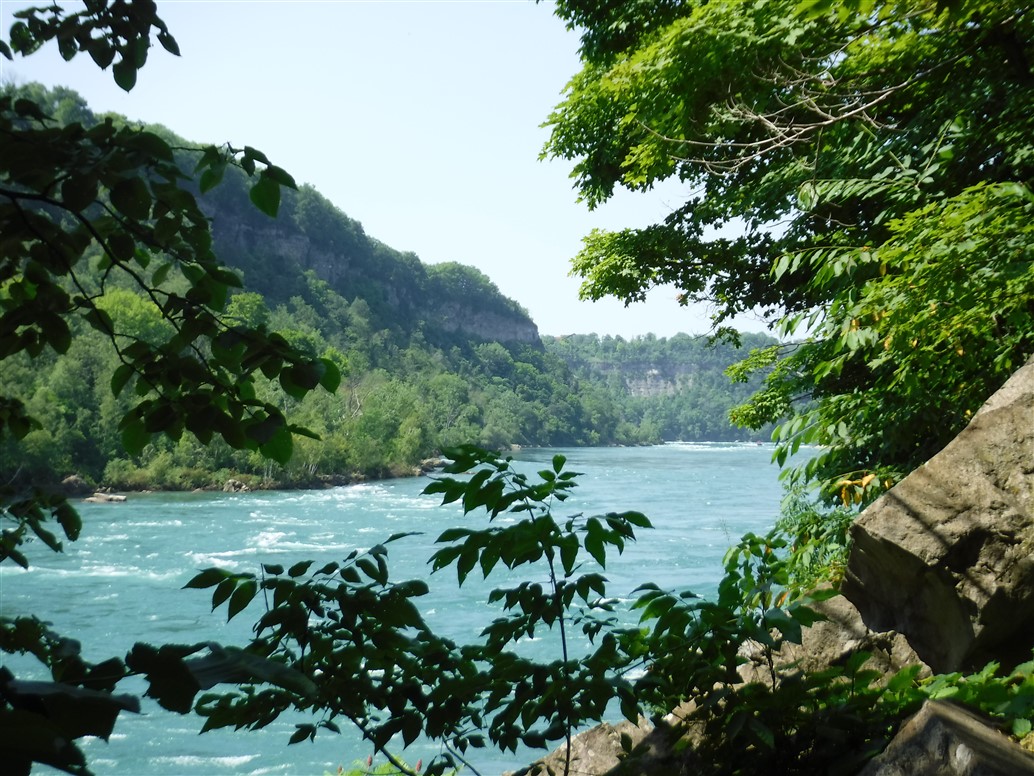
Niagara River

Taking a cool break in the Niagara River before climbing back out of the canyon

Jet boats on the Niagara River

Valerie and her partner at tennis lessons


Hiking to an Ontario falls

Ontario stream

Next we headed south and spent a day with a couple of our “adopted grandchildren” that we met in Belize in 2004.  At one point in their lives they needed some stand-in parents to help them along and we were the ones they were comfortable reaching out to.  Since then we have kept in touch and were very excited to see their new home in Ohio (a state that neither of us had ever visited before). 
From Ohio we headed pretty much east.  We camped on the shores of the Mississippi and Missouri Rivers and then explored the Bad Lands of South Dakota and on into the Black Hills to see Mt. Rushmore and the Crazy Horse Memorial.  After that we moved on to see parts of Yellowstone we had never visited before and took time to look at the trees that had grown up since we last visited in about 1986 when there were active fires as we passed through.  We have to say that Jarvis was pretty cool and calm as he and a couple of bull elk eyed each other from a fairly close distance (a small herd has set of camp in the campground so trying to avoid them is near impossible).  From Yellowstone we passed through southern Idaho where my brother-in-law grew up in a “three digit” (town with fewer than 1000 people) town.  We got to see the tiny town that boasts it was the first atomically powered town in the world (they forget to mention that the reactor also had the world’s first meltdown!)  We stopped to watch a tug and barge load lock past Bonneville Dam (just because that’s what boat people do) on our way through the Cascade Mountains via the Columbia Gorge. 

Sun sets over the Mississippi River

The Mississippi River was quite high so lots of water released over the dams

Badlands National Park

Prairie Dogs in Badlands National Park

Selfie at Mount Rushmore

Crazy Horse Memorial now has a finished face

On our way to the East entrance of Yellowstone NP

On our way to the East entrance of Yellowstone NP

On our way to the East entrance of Yellowstone NP

Yellowstone River in Yellowstone NP

Grand Canyon of the Yellowstone [River]

Lower Yellowstone Falls

Elk Yellowstone NP

Old Faithful Geyser Yellowstone NP

Yellowstone NP

Grand Prismatic Pool Yellowstone NP

Elk in campground Yellowstone NP

Bison in campground Yellowstone NP
Jarvis snuggled down in his sweater at our feet every night in the van 

Coming out of the Gorge we arrived in Beaverton where we spent time with our Grandson’s Mother  and our son with his new wife. Finally from there we headed north and stopped one more time at my 92 year old mother’s house and then on to Everett to complete the circle.

Now I have had my urology follow-up and new glasses made. Jarvis got a clean bill of health and a Rabies update. Clarice has new contacts and we both have some new cloths to replace those that show the strain of living outside with limited wardrobes.  Finally if we can get a box of parts and supplies that were mailed to Phoenix across the border with minimal hassle and the my replacement cell phone replaced (long story but it seems that Apple made more than one model of the SE and they aren’t quite the same) we will be ready to get back to our home and get her back in the water where she belongs.


Jarvis is the last one to make his doctor visit before heading back


Sunday, June 23, 2019

We reach the northern limit of the Sea of Cortez


5-16-19

After spending a week in Santa Rosalia we are headed north to the next well sheltered anchorage about 75 miles away.  Winds have varied for 16 knots to 0 knots and are now back to about 10 knots. Seas have ranged from calm to confused little waves of a foot or two to short period swell now of about 4 feet (which is kind of a bummer when it comes off of the bow as the short waves set the boat to “hobby horsing” from bow to stern but this is VERY common in the Sea of Cortez). Clarice is sitting in the captain’s chair with her bare feet up on the counter reading a guidebook and checking out the window and checking the instruments every few minutes. I’m sitting on the pilot house bench with Jarvis lying snuggled up next to me in his usual “underway position”.  I’m also keeping an eye on the radar screen with shows nothing for 6 miles around us except for the shore about 5 miles to our port side and we are watching a video feed from the stern to see if a fish happens to grab one of the lines we are trailing.  The outside temperature is already in the 80’s (Fahrenheit) at 9 AM with just thin clouds here and there that we expect to dissipate before long. We are listening to the Chubasco radio net on a ham frequency to check if there are any weather surprises that we didn’t pick up off the GRIB file download this morning (hmmm – the first tropical low of the season with has a very low chance of becoming a tropical storm/hurricane has formed down by the equator – need to watch that) and listen for any messages from our ham friends.  Heading towards us we see a pod of at least 100 dolphins so we will quickly pull in our fishing lines to avoid accidentally hooking one as they pass. In other words it’s a normal travel day on the Sea of Cortez waters.

Just to follow up on the previous paragraph it is now 12:30 and we are in calming seas after the water got rough enough that we ended up putting the paravanes in the water to smooth some of the fore-aft motion and I pulled out the Gin-Gins (ginger candy that helps with early motion sickness).   Clarice had noted some horizontal clouds over the peninsula mountains this morning and remembered one of the guide books saying that in this area there are some low areas in the mountains and there is a cloud pattern that indicated strong westerlies coming from the Pacific Ocean.  I think she got it right as the seas were ugly for about 1 ½ hours and then the winds and waters settled down although we could still see the waves behind us on the radar.  So we are in calmer waters and now have very very large whales (species yet undetermined) on all sides of us.

We managed to get just enough internet in one of our prior anchorages to learn that we were at risk of losing our insurance on June 1st.  We knew that our coverage year with Lloyds of London would end mid-July and so we had been communicating with our insurance agent in Maine about our plans for the next year.  Our agent caught that we planned to be in the Sea of Cortez in June and July and pointed out that our policy stated we needed to be OUT of Mexico from June 1 – November 1st (we had blanked out on that detail as we believed we hadn’t planned to have an extended stay in Mexico until we got here and changed plans).  We had enough time to get back to San Diego if we did a 24/7 run but this was the opposite of what we wanted to do.  Long story short is that we have resolved the insurance issue and will now have a new underwriter who is much more familiar with Mexico waters.  The new policy will cost about $5000 USD/year and require that we get the boat surveyed (add about $1000 USD so someone can say the obvious (that the boat is in good sea shape)).  The policy is OK that we stay is Mexico as long as we stay from about La Paz north with fits in well with our plans. Getting this whole mess straightened out was a major reason for putting into Santa Rosalia where we had good internet and cell service for a week.

We had our first pleasant surprise when we walked up to the office at Marina Fonatur and were told by a very helpful young woman that our base fee would only be about $2000 Pesos (about $100 USD if we stayed for a week) plus fees for metered power and water.  Not only were the fees much less than we have grown accustomed to but the docks themselves were in excellent condition.  Fonatur is a government agency that has built a number of tourist facilities (including marinas) to try to attract outside money into the country.  Some of the facilities have been privatized after they became known for poor maintenance, some continue with reputations of poor maintenance and then some are like the Santa Rosalia marina where the staff clearly takes pride in the upkeep of the facility.  It wasn’t one of the fanciest places we have stayed but Clarice enjoyed the pool (as did Phoebe an 8 year old visiting her grandparents’ boat berthed next to ours).


Santa Rosalia Marina Fonatur

I find mines and minerals to be fascinating and Santa Rosalia is through and through a mining town.  Back in the 1800’s the Boleo Mining Company was incorporated in France and then came to Mexico to harvest the rich deposits of copper in the hills around Santa Rosalia.  The “easy” pickings were cleaned out in the 1980’s and the mine was closed until 2005 ish when a Canadian/South Korean company invested billions of dollars into new smelting processes, a new shipping wharf, and reopening the mines and they are now again shipping copper, zinc, and manganese.   Also on an island just off Santa Rosalia and just south of town are gypsum deposits that are quarried out and shipped out as another mineral bonanza.  The original smelter is rusting along the waterfront (part of it has been restored enough as the beginning of a museum to go along with the main mining museum in the original Boleo Company headquarters), the breakwater around the marina is made of slag from the old smelter and huge piles of glass sand are on the hills also left over from the smelting process.  The beach in town is called Playa Negro for the black glass sand that was originally deposited into the bay and now has washed ashore.  Throughout town are holes in the hills next to the roads that must have been old shafts of some kind but are now blocked off.  The little town has quite a few old steam locomotives on display that were the work horses above ground for moving the mine products around (displays shows mules or donkeys doing the work underground).  Most of all the town has a “company town” feel about it will many old clapboard buildings and red tin roofs.


Old mining machinery on display

One of several steam engines left from the mining days

The original smelter ruins

More of the smelter ruins

Note how the toxic smoke was run up a hill to dilute it over a larger area
A true ADA playground!!


One of the fascinating finds in town was a steel church imported by one of the mine owners.  It is believed that the church was designed by Mr. Eiffel himself and was displayed at the Paris Exposition next to the Eiffel Tower before being disassembled and moved to Mexico.  The building is an acoustical disaster but the historical significance made up for the priest and musicians having to use a sound system.  We did attend one service in the church and it was clearly a very active place with a number of services each week and excellent guitar and vocal music.  I mentioned to the priest (poqueno ingles to go with my poqueno espaniol) that I had never been in a Catholic Church before with an empty cross to which he pointed to the Christ statue “walking” next to it.  Having grown up with protestant traditions this makes much more sense to me as Christianity is based on the belief in a risen Christ.


Steel Church designed by Gustave Eiffel
Inside of Steel Church

"Naked cross" and walking Christ

This was another place where I was really glad to have my electric assist bicycle so I could explore the town which is all uphill from the marina.  Again I found myself checking out the cemeteries on the hills overlooking the waterfront.  It gave me pause to notice how many of the recent graves showed dates of birth after my own suggesting that life expectancy in the town is still not long.  Apparently this was like many smelter towns (including where I grew up in Tacoma, Washington) where the smelters belched many toxic wastes into the air for years.  In Tacoma ASARCO’s answer to complaints was to raise the level of the top of the smokestack and spread the wastes further, in Santa Rosalia they moved the stack to the top of a hill with the same outcome. I cannot say for sure if that is the basis of the short life expectancy but it would be something to consider in a study.  Another part of the cemetery that gave me chills was a section (later I noticed several other sections like it) where there were small piles of rocks over unmarked graves most likely of very small children.  Without any dates or other information I can’t tell for sure what happened but this would be a common sign of an epidemic passing through.  I wondered if people who don’t believe in vaccinating their children would understand the potential cost of their choices if they stood in the midst of those piles and listened for the cries of the dying children.


Hilltop cemetery

Looking out toward the sea from the cemetery 

Unmarked children's graves

More unmarked children's graves

The crosses on the hill

We learned that there is no car rental agency in Santa Rosalia and as it hasn’t really established itself as a tourist town even though Mexico highway 1 passes through it so there wasn’t any tour services either.  In order to get out of town and see the scenery we decided to hire a taxi for a day.  The driver didn’t speak English but he was a very good man recommended by the marina manager and we worked all day on practicing language.  Our goal was the town of San Ignacio just over the divide in the middle of the Baja Peninsula.  We paid him about $100 for 6 hours of playing tour guide to the two of us and Jarvis (whom he had agreed the evening before would be OK in his cab after some local ladies pointed out that Jarvis was very well trained).

On the way to San Ignacio we passed a number of very old volcanos but on further examination we realized that some of the lava flows didn’t look that old in geologic time (we now believe they are from the 1700’s).  The overall scenery driving up the road to the town was lovely desert and mountains.  The town itself is GREEN!!! (OK we are from Washington, The Evergreen State and miss GREEN) as it is built in an area of springs and even has a couple of shallow lakes.  Entering town you drive through hundreds of closely spaced palm trees and then the town square is shaded by trees a couple of hundred feet tall. This is another town with a very old mission church (and once again I took the opportunity to sing in it so I could listen to the walls singing with me).  Our driver introduced us to an American woman who owns one of the original large haciendas in town.  She maintains the home almost like a museum and was eager to show us around and to answer many of our questions about the town.  We ate lunch and then started back down to the Sea about noon and felt like it had been a very good day and that our taxi fare was well spent.


Volcanoes along the route up the mountains
A fairly "recent" lava flow

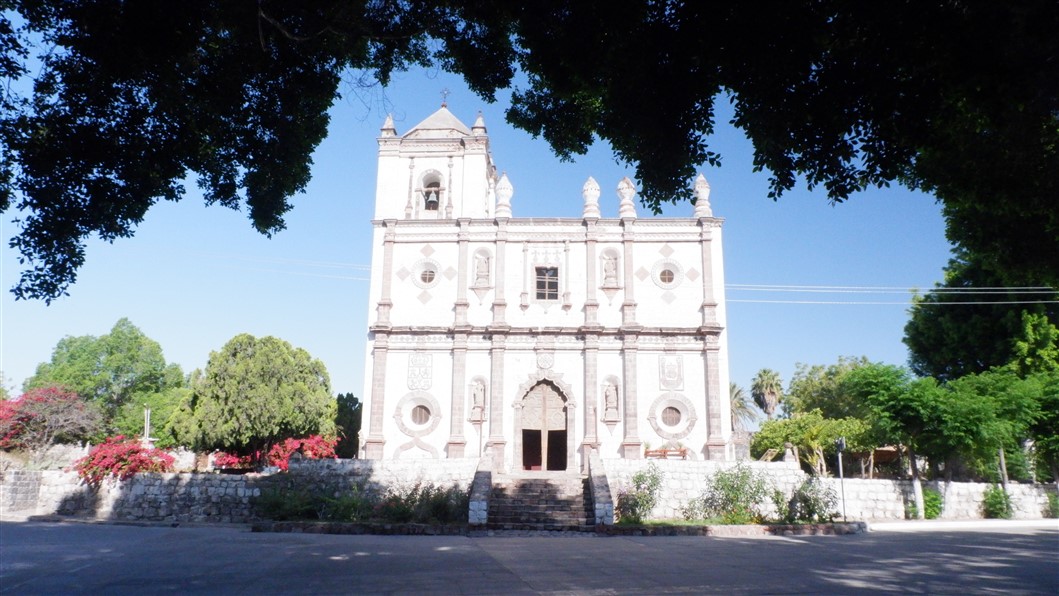
Mission in San Ignacio

Inside the Mission in San Ignacio

Mission in San Ignacio

Town square in San Ignacio (first tall shade trees we have seen in Baja)


June 21, 2019

After Santa Rosalia we had hoped to enjoy some of the outstanding clear water diving we had heard about.  We have so far been pretty disappointed as the plankton blooms are pretty thick everywhere we stop.  We have passed through a number of areas of red algae (AKA “red tide”) so thick it made the water color range from brown to blood red. The only tradeoff is the evening and night phosphorescent shows are spectacular.   We moved up the north end of the Sea of Cortez at a fairly fast clip as the anchorages and marinas are getting fewer and farther between.  We did stop at a group of islands known as “Refugio” we could see why this little archipelago is the destination of a lot of campers and boaters as the scenery is spectacular and we are likely to go back that way on our trip south in August.  The other disappointment (besides the clouded water) was the amount of camping garbage on the beaches.  (We later heard from our friends on Saare Lil that they had met several “kid boats” in Refugio and that some of their fondest memories of the Sea of Cortez were formed while they were there.)

We rather suddenly found the water under our keel rapidly shallowing as we entered the realm of the Grand Canyon of the Colorado (or at least the sand washed south for zillions of years from its formation).  The Colorado river no longer reaches its natural terminus in the Sea of Cortez as every drop of water is pulled off to feed agriculture, provide drinking water and fill swimming pools as it heads south.  On the other hand the delta that remains is a clear testament to its history of power and Earth shaping through the ages.

Recognizing that we had sailed into an area of shifting sands we watched our charts and depth sounder readings very carefully.  When we enter the breakwater of San Felipe it looked like we wouldn’t have any problems but when we looked off our stern the next morning at low tide we realized that at least 50% of the area within the breakwater area is silted to the point of being dry land at the lowest tide.  Thankfully other mariners had added notes via a crowd sourcing program to our electronic charts which gave us a heads-up on how to approach the Marina Fonatur dock. 

After our last stop in Santa Rosalita we weren’t surprised at the low cost of staying at a Fonatur Marina but we were not happy with the condition of the docks.  In fact after a very long day at sea I recall feeling pretty let down when I realized we would be moored at a dock that was long past its’ prime in an industrial area a few miles from the main part of town.  What we eventually found was that Fonatur had repaired the upland parts of the marina and was actively working to rehabilitate the docks (they put several rebuilt sections back in the water before we left).    Security was very good with up to 3 Coast Guard boats at the dock (with at least one of them crewed at all times) and a full time security guard. Town was a fair bicycle ride away with the biggest challenge being that thorns hidden in the sand along the road kept puncturing our tires. 

On the way to San Felipe we had ordered a new sewing machine for the boat.  It is simple (kinda old fashioned) but built specifically for sail and canvas work.  The machine was to be sent to our friend’s business in San Diego for pick-up.  We also wanted to get some new watermaker membranes and convert our system to be able to use less expensive generic sizes.  A company in San Diego had the parts in stock and would not charge shipping if we picked them up at their assembly shop.  Finally we had a long list of marine parts we wanted to pick up and NOT have to try to get them into luggage from Seattle.  With all of this in mind we found a rental car (in excellent condition) and drove on very good roads to San Diego while Jarvis stayed at a doggy spa.  While we were in San Diego we visited with our friends the Grays and with boating friends as well.  We made excellent use of our time and picked up everything without problem except for the sewing machine which had been loaded onto the wrong delivery truck by FedEx.  The good news was that we knew it was in the San Diego area if we could track it down and eventually while we waited at the warehouse FedEx found the box and handed it over to us the same evening it was supposed to have been delivered.

Once back on the boat we were able to upgrade the watermaker and are very pleased that it is making about 40 -45 gallons per hour rather than the 25 gallons per hour we could get from our old membranes (we were especially pleased as we had been told to expect only about 30 gallons per hour until we had a chance to upgrade our high pressure pump).  The sewing machine challenged Clarice a bit as she got used to its idiosyncrasies but her first project with it was produced with about one tenth of the frustration that she had with her dressmaking machine and the stitches look much much better.


New membranes (blue on right) installed under bed

Clarice studies her new sewing machine

While eating dinner we met an expat couple who own a home in San Felipe.  They gave us a ride back to the boat and then visited and asked a lot of questions about our craft and living on it. During our stay in San Felipe they introduced us to dune buggy riding on the beach and in the arroyos and took us to see some of the sights in the area.  Joe used to sail on the Nimitz which for some time shaded our passage as we left our home port in Everett where it was docked. As such he was very familiar with boating systems and jumped at the offer to join us as we sailed across the Sea of Cortez to Puerto Peñasco (even choosing to sleep in the pilot house berth as it reminded him of his bunk on the aircraft carrier).


Baja Buggies

Buggie ride on the beach

New friends take us to a giant saguaro reserve

Speaking of the Colorado River Delta, like the Columbia River Delta back home it has created miles of sandy beaches.  Just outside of the breakwater was a beach that ran for miles and was very very wide at low tide (the tides at this end of the Sea of Cortez run up to 14 feet).  Jarvis was in little dog heaven for every morning and evening run on the beach.  There were many opportunities to increase his calcium intake sneaking fish bones off the beach when he thought we weren’t looking.  There were pelicans and other birds to chase and most of all there was lots and lots of room to run as fast as his little legs could go.


Jarvis was in doggy heaven on the sand beach in San Felipe

We are currently in Puerto Peñasco waiting for our planned haul-out next week.  Again we find ourselves at a Marina Fonatur and in a commercial harbor with many huge shrimp boats tied up together and a number of tourist boats ranging from “booze cruise” boats to “pirate ships” all of which seem to find it necessary to have VERY loud sound systems which start blasting music and other noise at about 6 pm while they load for the evening sunset cruises.  Other than that we have found its not too far of a walk or bike ride to the larger stores and to the sand beach that attracts hundreds of folks from Phoenix and Tucson.


Sandy Beach Puerto Penasco

We have run into a number of boats getting hauled in the same yard as us and in many cases they are part of the community in motion that is the reality of long distance cruisers.  We had friends who needed a ride to Phoenix where they could rent a car one-way to California and other friends who needed a ride to the airport in Phoenix to catch a flight back on their way to home in northern Alberta.  We found that we could rent a mini-bus for about $US 200 that would carry all 12 of us and had a roof rack for the baggage.  We drove the van north and enjoyed the scenery and picked up some new bicycle tires and puncture resistant tubes then spent the night in a nice motel before driving back the next day with a stop in Oregon Pipe Cactus National Monument. (Sadly after feeling very good about Jarvis staying in the kennel in San Felipe, I wasn't pleased with him being left in a cage in Peñasco - Clarice has been trying to convince me that Kennels are a good option at times but I will have to use a lot more care in choosing them before I will be willing to leave Jarvis with strangers again.)


Mini bus trip to Phoenix

DANGEROUS IN MEXICO???

About once every week or so we hear how dangerous it is in Mexico. Just today I had a person write a response to my TripAdvisor information about driving to Phoenix and back asking, “How safe is the travel from Phoenix to Puerto Peñasco currently…. Any issues to be aware of?”.  This was after a friend of Clarice’s had reported that her brother in Phoenix wouldn’t take her on a side trip to Rocky Point (the Gringo name for Puerto Peñasco ) because it was too dangerous.  Here is the response I wrote to the latest question, “We did not experience anything that concerned us driving between Puerto Peñasco and Phoenix and back. We have been advised by more than one expat living in Mexico to avoid driving at night. The only reason given was a concern for blowing sand on the coast road from Puerto Peñasco to Mexicali. We have heard more than one claim of "its dangerous there" from Phoenix residents - we don't know the source of the concern. We have been moored on our boat in the seedier part of town (its the only place to moor a boat) for a couple of weeks with walking and bicycles being our primary means of getting around and using common sense have been no more concerned than walking in the seedier parts of any USA city”.

On Facebook it is consistent that those of us who are here will write that using the same level of vigilance in the places we have visited that we do in USA cities has kept us safe so far.  We were most concerned about pilferage from our boat and dinghy in San Diego so we always locked the dinghy and bikes carefully.  On the other hand I have not seen my cell phone for several days and am convinced it was palmed while we were at a restaurant here in Puerto Peñasco .

Going back into the USA we were stopped twice at border patrol check points away from the border.  We were only asked if we had “appropriate ID” and sent on our way without actually showing any ID (the agent was caught a bit off guard when he asked if everyone was a US citizen and I replied no that we had Canadians in the vehicle).  This continues to feel “not right” to me after having lived near the border with Canada where such check points are rare to non-existent.  Perhaps it goes back to my youth and childhood when I heard over and over about the evil East Block countries that required citizens to carry identification papers at all times and that it was a sign that America was a great country because we had the freedom to travel without being stopped.  Here in Mexico we often are stopped at military check points and the officers all carry automatic weapons but this is not MY country and I don’t expect to have the same freedoms here as in the USA. 

Speaking of which a common question that comes up on the cruisers’ forums is about carrying firearms on boats.  The common answer is it is a pretty stupid thing to do unless you like visiting foreign jails or having your boat confiscated (answer to the next question: we carry bear spray in case of a low level piracy attack – for a high level attack they can have the boat and we will go overboard in the life-raft).  Clarice ran into that worst case “ugly American” response on one forum when someone wrote in, “but it’s my constitutional right to have my guns”.  All we can say is that if you don’t understand that the US constitution only applies in the USA then please go back and take 6th grade civics and for the sake of the rest of humanity get rid of your guns as you are too stupid to own them responsibly!

So to end this section of random thoughts, I have to ask what makes us feel safe or not safe.  Someone wrote that the Mexican police presence with them all carrying automatic weapons made them not feel safe.  Curiously I think that many of the police on the corners in Cabo are there for show so that the tourists worried about drug cartels will feel protected. On the flip side I have long had a bad taste in my mouth from visiting Phoenix in the 1970’s when I was a high school student with pretty long hair.  I was riding my bike down the highway and was randomly pulled over by a police officer in a car (not a motorcycle) who got out of the car with a riot helmet on.  I remember being struck by the barrier the officer had created between me and him just because he felt a need to look “tough”.  Every since that incident I have been a big fan of “officer friendly” type programs and have gone out of my way to say hi to cops on the beat (especially those on foot or bicycle) in appreciation of how little it takes to make a wall between us. In another instance I recall a student MD visiting our clinic in Belize complaining that there wasn’t a phone in the dorm and what would they do if there was an emergency.  What she hadn’t taken the time to consider was the reality that the police might ask for her to drive and pick them up as they often ran out of fuel part way through the month, and had they responded they might have not been impressed at her complaint about a robber who happened to be the cop’s brother-in-law.  What does this all come down to?  In the end “being safe” is a very culturally based concept and varies greatly from place to place and person to person.  If you are going to travel then you are going to have to get used to being responsible for your own safety and recognizing that every choice you make from what you wear to how your body language expresses confidence, to where you choose to travel and at what times defines how safe you are likely to be.

So is it safe in Mexico? Yes and no.  Is it safe in Seattle? Yes and no.

Parting thoughts and photos before I publish this post:


  • In the May post I wrote about trying to keep my nursing brain functioning.  The current plan is that in September and October Clarice will stay in a marina in Mexico where we have a number of friends and work on boat projects (and hopefully have a long-time friend of hers visit) while I head off to Hillside Clinic in Punta Gorda Belize for a month.  This is the clinic where Clarice and I spent the year of 2004 in the very southern tip of Belize Central America.  A funny aside is that one of my motivations for choosing the clinic was that my Belizian nursing license specifically says, “without limit of time” so I assumed it was still valid and I wouldn’t have to go through the hassle of getting license reciprocity in another state or country.  The clinic director had never seen such a thing as the Belizian licenses now are time limited but on checking with the national board it was confirmed that my license is still active. (I have always joked that I go through a sex change when I enter Belize as well as the licenses of the era only had female pronouns even though I know of at least one other male who was a nurse in Belize at the time.) Hillside Clinic Belize


  • Boat Projects: Clarice is focused on getting the boat clean and ready for our haul out. I completed another room of my floor sanding project.
Sanding the floor
Floor after varnish (it was the sun bleached color of the vertical wood)


  • We have received word that the school we have been supporting is Esperanza near La Paz is near ready for students.