4-30-19
We seem to have passed a transition zone in the Sea of
Cortez where the scenery changes as well as the wildlife. One way I monitor if it’s time to start
typing a new blog entry is to watch the number of photographs collecting on my
desktop. When the number starts to climb
rapidly it means we are seeing new sites that we are eager to keep a memory of
and thus there are more adventures and sights to share.
Some time back I had downloaded several audiobooks thinking
that I would use them to help me stay awake on night crossings but since we
have not made any night crossings the books have stayed on the electronic
bookshelf. One of the books is the Log of the Sea of Cortez by John
Steinbeck and co-authored (per Steinbeck according to the introductory
information) by biologist Ed Ricketts.
The book was taken off of the shelf a few weeks back when we got an
email from a friend we had gone to church with in Sitka Alaska reminding us
that Ed Ricketts family were long time members of the church and had worked to
keep his legacy alive. Their boat was
the Western Flyer built in Tacoma and seen by Clarice and I both as we past it
moored in the Swinomish Channel (before it sank) and later while it was in the
beginning process of being restored at the same shipyard where we had Salish
Aire hauled out back in August https://www.ptleader.com/stories/work-ramps-up-on-western-flyer,58805?.
The timing for beginning to listen to the book could not have been better as
Steinbeck and Ricketts stayed in many of the same anchorages that we had and we
were able to mentally compare what he described from the WWII era with
today. The only place that seems to have
changed completely is the area at the tip of the peninsula where Cabo San Lucas
has been planted (and grown into a rather unruly mess in our perception). The coves and other sites he tells about are
still there today just as he described them.
Even his description of entering La Paz has not changed nearly as much
as one would expect with the sand bars just as he described them and the range
(navigation) lights still in the same locations. I am now at the point in the book where he
describes the changes in what they are observing and we are seeing pretty much
the same things as we move northward.
In Steinbeck’s book I have just finished the chapter on
Puerto Escondido which seems appropriate as the last blog note ended with our
entry into the harbor but with little description of it. Steinbeck describes Puerto Escondido, the
Hidden Harbor, as “a place of magic” and comments on how perfect of a natural
harbor it is [Chapter 16]. It is such a
perfect harbor that we had questioned if perhaps two areas between hills
surrounding the harbor had been filled in as man-made breakwaters but since
Steinbeck also mentions them as present when he visited the bay they are
clearly natural. To enter Puerto
Escondido the navigator must first find the narrow entrance hidden among the
hills. Thanks to unusually accurate charts and GPS this was not a terribly
difficult challenge in 2019. You then pilot the boat nearer the reportedly
deeper south side of the narrow entrance channel (now dredged but not deep
enough in Steinbeck’s time so that his crew chose to anchor in a cove next to
the entrance now known as the “waiting room” as larger boats sometimes anchor
there while waiting for a high tide).
Once inside of the channel the harbor is nearly a perfect pool and quite
deep. The water was not clear for us as
algae tends to bloom in enclosed harbors and when we lost our boat hook in 40
ft of water it was lost for good since I
could only see about 2 ft when I dove to the bottom to look for it.
 |
| Puerto Escondido |
Puerto Escondido keeps trying to make itself into a very
high-end marina and housing development.
Initially the project was started by the Mexican government but it
wasn’t well maintained even though they had built some well-designed buildings
and some of the nicest boulevards we have seen in all of Baja. A
couple of years ago it was taken over by a private concern and they have
upgraded the docks and built a 6000 Sq ft hacienda between one of the dug canals (with private
docks) and the lovely boulevards. On one
hand I wish them the best with their endeavor but on the other I would really
hate to see this incredible natural setting become another Cabo.
Puerto Escondido is about 20 minutes south of the town of
Loreto by car on a highway in very good condition. We rented a car and used Puerto Escondido as
a base for several days of exploration and provisioning. Loreto is the oldest non-native settlement
in Baja with the oldest mission church.
Steinbeck visited the same church and commented about it being in ruins
with the roof fallen in and only the bell tower and one small chapel
standing. The church has obviously been
rebuilt since then and is now shared as a museum. We had looked forward to Easter Sunday in
this culture that we considered to be “very Catholic”. We scoped out the mission on Saturday
afternoon and understood that that church was closed until 7 PM. We assumed there would also be a Sunday
service and after talking with several people were convinced it would be at 7
AM. We arrived at 7 AM Easter Sunday and
the building was locked. At 7:30 the
bells rang and the building was opened to the public but no formal
service. We came to believe that the
service the evening before had been THE Easter service. Since it was still early and we had been told
that the mission church at San Javier high in the Gigantic mountains was well
worth the drive we decided to head there.
Steinbeck describes going up a mountain trail out of Loreto to go
mountain sheep hunting. While they never
did see any sheep they loved the trip and spent a night at a cascading
stream. I strongly suspect that the
trail he followed was to the San Javier Mission and that the road now follows
much the same route. I even believe that
a spot where I commented to Clarice about it would be amazing to see in the
spring with water falling over the cliff may well be the same spot where
Steinbeck’s party camped.
 |
| Mission at Loreto |
In any case we drove up and up on a very windy mountain road
that was thankfully in excellent condition.
While the scenery along the road was spectacular we kept wondering why
the crazy Jesuit priest had gone way the heck up in these mountains to
establish a mission. Once we arrived we
understood as there was water. The
mission is in a valley where even in late May there was running water. The mission was really quite lovely and it
has aged well since being completed in 1758 on the site where the mission was
founded in 1699. Many of the original
irrigation works made for the mission gardens are still intact. The oldest olive tree in North America is
also on the grounds having been started along with a vineyard (gotta have that
wine!) by the priests. We were able to
establish that the Easter service was scheduled to begin at 1 PM so we walked around town, napped in the car
and in general got very warm in the heat.
Finally at noon we agreed that since scheduled at 1 PM in Mexico likely
meant a 1:30 start and since we had a dog in his crate on the boat, and a 1
hour drive back down the mountain, we would forgo Easter services this
year. We were able to contact some friends
once we were back in cellphone range of Loreto and that led to an enjoyable
afternoon.


Back in the Episcopal Church we attended in Snohomish
Barbara and Bill Bates and their children were major pillars of the community
and the church. While I only knew them
from church, Clarice being native to Snohomish, had gone to school with one of
the Bates’ daughters. Another friend
from the church follows us on Facebook and noted that one of the Bates sons and
his wife were at their second home in Loreto so she put us in touch. While neither of us had met Stuart or his
wife (also a Barbara) we fell in easily with them as they clearly had the Bates
family trait of being “good people”.
They came out and visited us in the marina and on the boat for Easter
afternoon and offered to take us to see their home and the town the following
week. The day that we visited them at
their home we were impressed at the housing development where they live and
even went so far as having a realtor show us around in case either of our
children wanted to go in on a place in Mexico (they didn’t).

A little about the changes in what we are seeing in the
Sea. We are diving more as the water is
starting to warm up a bit and get clearer.
We have been told that the northern Sea is a divers’ paradise especially
when the water clears in the summer (the exact opposite of what we are used to
from Salish Sea diving). The numbers
and variety of sea critters are clearly increasing although the water is still
fairly cloudy at depth. In the shallows
where we snorkel the water is often crystal clear with huge varieties of
animals. Steinbeck mentioned swimming white crabs about 2 inches long that I
had never seen until a couple of nights ago.
Most nights we hear many splashing noises as fish gather around the
boat. The light from our windows and
deck lights attracts millions of krill and other tiny tiny life to the water
next to the boat which in turn attracts schools of small fish (and the other
night probably 100ish little swimming crabs) which in turn attracts schools of
larger fish including one evening a 4 foot green eel swimming near the boat and
another night a sea snake or small eel.
We delighted in seeing 6 inch flying fish with their gossamer “wings”
swimming just under the surface and periodically “flying” across the
surface. When we turn a strong
flashlight downward we have a virtual aquarium right next to the boat.
Today as we motored north to the anchorage at San Juanico we
were delighted to see a pod of 100 or more dolphins heading towards us. I put the 400 mm lens on the camera as they
were expected to pass at least 200 yards to our starboard side. Just as I was finishing setting up the lens
the dolphins decided we looked interesting and did a 90 degree turn to visit
within a few feet of our hull. I tried
to get a video with entirely the wrong lens but at least a couple of frames
could be pulled out. In any case it is
always very exciting when the dolphins visit as they seem to be as aware of us
as we are of them and they seem to exude pure joy as they play in our bow wake
and leap out of the water. When we were
near the entrance to the bay (with three sets of charts which all showed rocks
and islands in entirely different locations) we saw areas of brown in the blue
water. We immediately slowed the boat
and I went to the bow to try to ascertain if there was a reef near the surface
that threatened to ground us. What we
finally realized was that we were seeing an orange/brown algae bloom. The water here in the bay is currently thick
with green and orange algae after friends told us it was crystal clear this
morning.


Friends on S/V (Sailing Vessel) Korvessa had mentioned that
the night before the bay was alive with phosphorescence after dark so we made a
point of checking the water after watching a video and wondering if the algae
bloom might be a portend to a big light show.
To say the bay was alive would be a huge understatement. We have paid to go on trips to so called
phosphorescent bays and they were only a 10th as bright as we saw here. The millions of krill each caused a minute
sparkle in the water as they moved about like twinkling stars. Below them as deep as maybe 8 or 10 feet we could
see the clear images of fish swimming past.
In the distance fish jumping would appear as a flash in the dark. Overhead it was a moonless night with
zillions of stars so bright that their reflections completed with the
phosphorescent images in the water. THEN
came the final act! About 1:30 AM Jarvis
woke me with a gentle "woof, woof".
Not his usual "I gotta get a drink and pee" bark but enough to
waken me in any case. While he stayed on
his bed I went up on deck to check things out and was rewarded with a scene
straight out of a Disney animation movie.
A parading school of rays about 20 feet wide(each fish about 2 feet
wide) was about 10 feet off our
bow. I could not see the front of the
line in the distance but could only see the rear guard coming so when Clarice
didn't respond to my call I stood watching alone. Under the Milky Way the rays were each
clearly lit with the blue-green light as they flew through the water slowly
flapping their wings with a few breaking the surface to make even a brighter
light. My only wish was that I had the skill of Jeremy Gregory or Elise Lebeau
to put brush to paper to record the scene as our earlier attempts to photograph
the lights proved our cameras were not up to the task. Truly this will be one of the most magical
nights we have ever experienced in our memories.
 |
| Using our most sensitive camera and with Clarice swishing a kayak paddle the best we could do was give an idea of the glowing color of the water |
I have always wondered how the great baleen whales and whale
sharks could live on the tiny shrimp known as krill. How could they possibly gather enough of the
tiny creatures to make a meal for such huge animals? We now understand krill better after seeing
them swimming en-mass under our flashlights at night and seeing how many cling
to our wetsuits after we clean the bottom of the boat. The primary stuff that clings to our main
hull here is a thin layer of some kind of biological slime which comes off easily
in sheets using 12 inch wide stainless Home Depot plaster knives. Apparently the krill live in or on the
bio-slime and when it is stripped of swim to the nearest dark colored refuge
which happens to be our wet suits. The
other day a friend mentioned that he had been paying to have his keel cleaned
only to find that the diver was only cleaning down as far as he could see with
a quick inspection. On closer inspection
he found that his wing keel was not being touched especially on the lower
surface. He was trying to catch up on the cleaning by free-diving (breath-hold
diving) and using a 3 inch wide putty knife.
I offered to take a look at the keel after we had been on a recreational
dive and I had a lot of air left in my tank.
When I got to the bottom of the keel I found hard growth as thick as 2
inches and had to whack it as hard as I could with my plaster knife. I was thinking I was glad that no
representative was in the area from the save-a-reef association as they might
immediately serve me with a stop work order for destroying a new reef in
formation. On the other hand I thought
about suggesting that Mark try to make some income by offering his boat as a
model for the next Disney movie, perhaps the next Pirates of the Caribbean
filming could use it as a ship that floated around the sea after having been
abandoned and was being slowly reclaimed by Poseidon. In reality the growth slows a boat noticeably
and costs a lot of fuel when underway using the motor so it is best to keep the
boat’s bottom clean and so I whacked and scraped and eventually was able to
clean the whole hull before my air gauge showed I was below my safety reserve
and needed to surface. On surfacing I
found that every bit of my suit and gear were covered as deep as 3/16 of an inch
with krill. I rubbed off as many as I
could in the water and then had Clarice spray me with the forceful stream of
our seawater rinse system and finally I stripped and she rinsed my gear again
in fresh water while I took a shower and got most of them out of my hair and
off of my body (I think the final one was cleaned out of my ear a day
later). In summary we now viscerally
understand that there is enough krill in the ocean to feed the great creatures
that depend on them.
Speaking of charting challenges, we were given a free set of
electronic charts on the agreement that we would help show the variations
between those charts and another set we had paid for. I will include a sample of one variation that
we sent to the chart company. All we can
say is that we were certainly spoiled in British Columbia and Alaska where
rocks are charted within a couple yards of their actual positions. Here we give ourselves a +- of about 1/8 mile
and recognize that many rocks are not charted at all.
 |
| Map data program "A" |
 |
| Map data program "B" |
 |
| Chart from guidebook |
One of our challenges is planning far enough ahead to have a
clue of what we are going to do and to keep our insurance carrier appraised of
where we will be within the next policy period but at the same time not over
planning to the point that we aren’t comfortable changing course if we simply
aren’t having fun anymore. Currently our
plan is to continue moving north in the Sea of Cortez to its very northern
reaches where we will have the boat lifted out of the water so that we can enjoy
some “vacation” time for the month of July.
After that we will move south as the hurricane weather allows and
eventually cross through the Panama Canal to the Atlantic Ocean. So the question comes up what is it we are
looking for – what is “fun” – what is “adventure” and to me I keep asking “what
is my purpose”. This is not the first
time we have asked these questions nor will it be the last. In any case I often find if I write down my
random thoughts they become more ordered and start to make sense.
For those who missed the detail along the way, Clarice and I
are both retired Registered Nurses (I am never sure if I should put “RN” for
fear someone will associate it with captaining a long distance pleasure boat
and assume it means “Retired Navy” which is absolutely not the case). We are both licensed in the State of
Washington (and also in the Country of Belize but that is another story) under
the category of “Active Retired” which translates to we can still work as RN’s
but aren’t required to put in as many “practice hours” or take as much
continuing education nor pay as high a license fee in exchange for the
limitation that we can only work a limited number of hours. Washington was clever in creating this
category in that it keeps nurses who might have stepped completely away from nursing
available to fill-in when there are shortages (which happens more often than
not in our profession) and it keeps we old mentor types around to pass on the
skills that are honed only with time. We
are both coming up on dates when we will need to either let our licenses lapse
or be ready to demonstrate that we practiced our craft and continued to study
the art. Getting the continuing
education is not the issue as we can always get credit over the internet if not
in other ways but we also need to do jobs that require an RN after our names if
we are to meet the practice hours requirement
and we are not sure at this moment how we will do that. I will speak for myself and say it would be
hard to set what has become a very significant part of my self-image aside on
one hand and yet I am very burned out on the other.
Back when I became an RN in 1983 there were very few men in
the profession. It was assumed that you
were ex-military or gay if you were a man who was a nurse and I am neither so I
felt even further afield. In many ways
it was fun to be “special” on the other hand I quickly learned that anyone who
is a leader (by plan or happenstance) is watched very closely. In my case I was also challenging tradition
and traditions don’t like to be challenged.
Early in my career I chose to be a labor and delivery nurse as we were
having children at home and I was excited to be a part of this time in my
patients’ lives. Not a lot of folks know
that my master’s degree is in perinatal (moms, dads, and babies) nursing. I am among a very small group of nurses who
specialized in caring for fathers during childbearing. The problem with this is that care of mothers
is traditionally women’s work and some of my co-workers went out of their ways
to protect that tradition which made my life difficult at times. I recall my first week working at a major
hospital where I was the only male nurse in the building when they needed a
model for some public relations photos.
I loved the work I did, I loved the hundreds of patients I cared for,
and I loved the hundreds of students I mentored as a professor of nursing and
as their supervising nurse in the hospital so why did I feel so unburdened when
I retired almost 2 years ago? About that
time either in an interview about her book or in her book, I can’t really
remember where she made the comment, Michelle Obama talked about her last
helicopter ride as First Lady. She cried
the whole ride in sheer relief. In
looking back she realized that as the first Black First Lady and the wife of
the first Black American President every word she said, every expression on her
face, every button on her clothing was scrutinized and she had to always be the
best she could be because she was setting the standard and a whole lot of
people wanted to see her fail. When I
read (or heard) that comment I realized that I felt somewhat the same as I had
spent from 1983 to 2017 being scrutinized and trying to always do my best
knowing that I was breaking barriers. It
was exhausting but with the pride I feel and the knowledge I carry and the love
I have for caring for patients and teaching new nurses I’m not sure I’m ready
to step aside. So keep abreast of the
blog and we’ll see what happens together and Clarice and I are still making
this up as we go along. The good news
is that when I talk to the many young men now choosing to be RN’s that they
assure me they have not experienced those same barriers so in many ways I
believe I left a solid legacy in that sense and made the profession better by
opening it up to a whole lot of folks who love what they do and are good at it
but might have never considered becoming nurses except those of us who took the
early lead.
Now back to moments that make our travels remarkable and can
never, ever be recreated on film or in a book.
These are the moments that happen at times when it just seems like we
are just “bobbing around in the ocean”.
Jumping back to Alaska I think of the bay in Kenai Fjords where we were
surrounded by at least 6 glaciers and could hear the hanging glaciers calving
into ice-falls and all-the-while a whale swam around and kept us company. In Alaska I think of sitting in a remote hot
spring, watching a couple of bears
forage on the beach while the sun was taking forever to set. Coming down the coast the first time we were
accompanied by porpoises and then later shutting off all of the lights on the
boat on my night watch and watching the phosphorescence from our wake and seeing
stars from horizon to horizon. Seeing
the rays swim past the other night looking like a scene from Finding Nemo
combined with Avatar is a moment that is almost beyond my own belief and I was
there! Finally we visited a mission
yesterday that was hundreds of years old.
We and friends and our taxi driver were the only ones in the chapel with
its four foot thick ancient stone walls.
I took the opportunity to sing with my full base voice and the walls of
the chapel came alive and sang with me, another experience I could only have by
being there at that moment in time. So
we will continue to bob around and be open to such wonders when they happen and
hold those moments in our hearts and do the best we can to share them with our
readers.
 |
| Mission Santa Rosalia with our friends from S/V Korvessa |
The final question about our purpose is still out
there. When Clarice and I started this
quest we were very clear with each other that we didn’t want to consider having
cocktails on the beach (the cruisers equivalent of golfing every day) to be our
goal in life. We wanted to feel that we
have given back to the communities and peoples we have come into contact
with. Helping with the school fund raising
was a part of that (although I’d much rather mix concrete and help with
construction than raise funds but that would be taking from the local laborers
rather than giving). We arranged for a parents’ night out for cruising
families with children and we have gotten to be known as the place to turn if
your boat breaks down or you need a hand.
These things make us feel valued but I’m not sure they rise to the level
of “purpose” yet. On the other hand, God
has always challenged my limited patience while he prepares me for His work and
this may just be another one of those times. (Maybe he thinks I should be able
to do more than order my meal in Spanish first – gotten keep working on my
lessons!) Again, keep reading our blog
and time will tell.
5-7-19
We still aren’t in an area with general internet access so I
will keep writing on the draft of this posting even though it is getting a bit
long. Yesterday we helped Korvessa take
on fuel from our tanks as they were getting concerned since they have used more
than planned between more need for generator use and less time under sail than
they had expected. In the evening we
moved a short distance to Bahia Burro with the plan of leaving early for a hike
up Bell Mountain. This morning we left
at 7:30 up what we thought was the correct trail (it wasn’t but eventually we
found the cairns that let us the right direction). The lower half of the trail pretty much
involved scrambling over rocks up a gully.
Later we intersected what appeared to have been a very old road of some
kind which left me wondering if it was an original mission trail or perhaps a
mine access route. The final fifth of
the route was short slippery switchbacks to the base of a rock pile that was
Bell Mountain so named as some (but not all) of the rocks that fall from it
ring like bells when struck. We still
cannot find any obvious difference in appearance between those that ring and
those that don’t but tapping them with the hardened tips of our hiking poles
quickly revealed the ringers. In any
case the sound was very distinct and very bell like on some of them. It did make the hike down the mountain go
more quickly as we tapped rocks along the way looking for the ones with
tone. It was especially interesting that
the ones that rang only seemed to have come from the single small peak. The trail was also reported to have
petroglyphs along it so we watched for them the whole way up and the whole way
back only to discover their location as we exited the trail. They were all within 30 feet of the highway
but at least we did get the satisfaction of finding them. Jarvis waited this hike out and was glad to see us when we returned to the
boat.
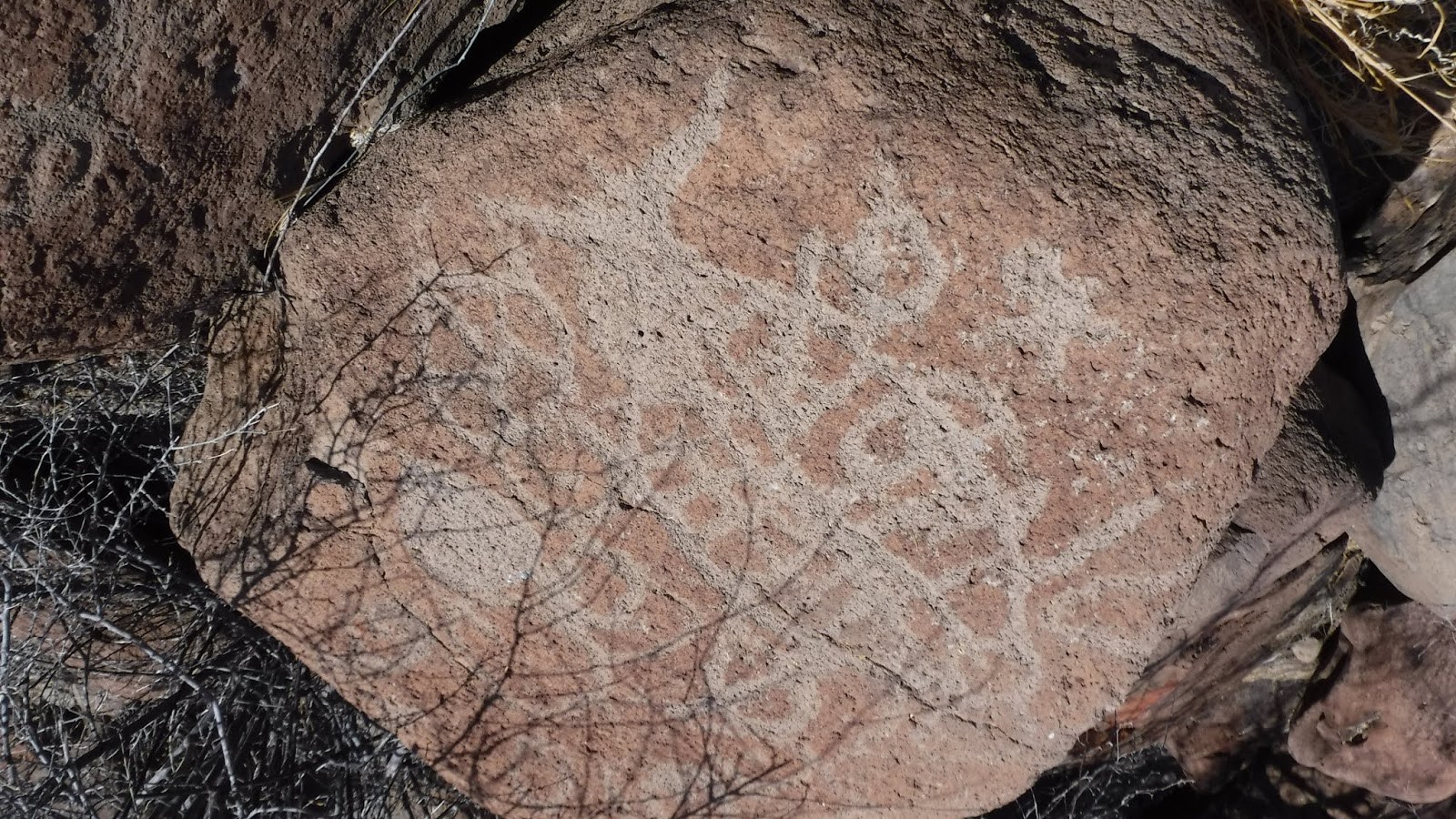 |
| Petroglyphs at the base of Bell Mountain |
 |
| Petroglyphs at the base of Bell Mountain |
 |
| The "bell" rocks seem to all come from the little peak in the center of the photo |
Video of the bells of Bell Mountain
 |
| Paddle boarder with whale shark |
 |
| Moonlit night |


 |
| Flock of "little diving birds" - a flock will suddenly disappear below the surface and then reappear a bit further on |
 |
| Clarice hiking |
 |
| Jarvis taking a break in his hiking boots |
 |
| Coronado Island volcano |
 |
| Salish Aire from the top of Coronado Island volcano |
 |
| These creatures cover themselves with other sea life we assume for camouflage |
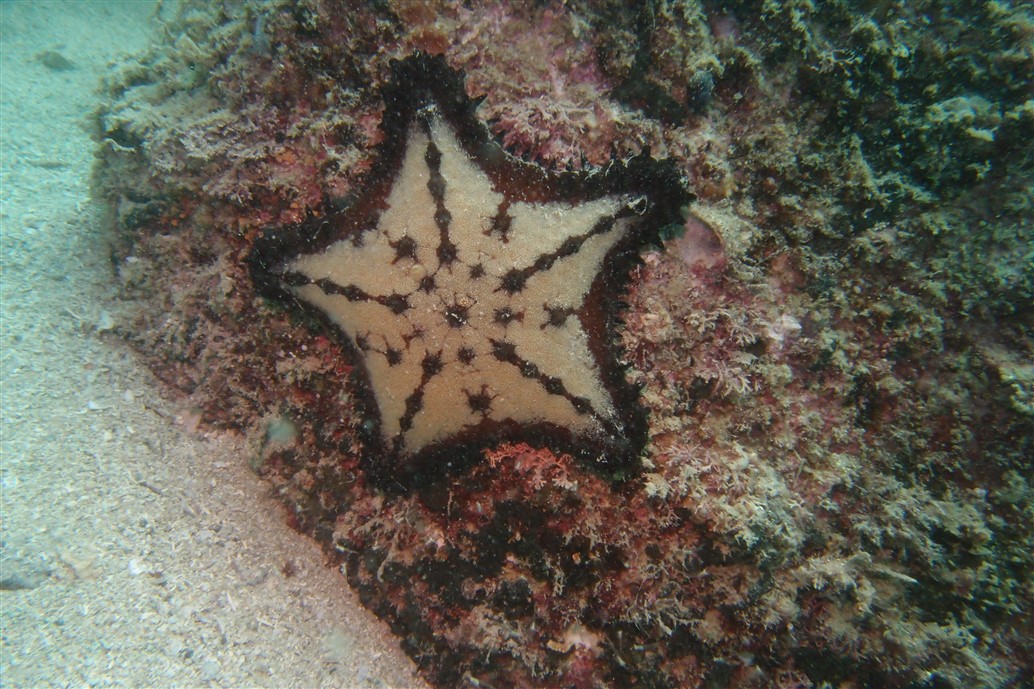 |
| One of many kinds of sea stars we see while diving |
 |
| A bulls-eye ray we saw while diving |


