Wow, have I been procrastinating getting an update done. I
see the last note ended when we were approaching San Diego Harbor.
 |
| Approaching San Diego |
 |
| San Diego downtown from our spot in the "cruisers anchorage" |
San Diego is a bit of a challenge from a cruising boat’s
point of view as anchorages are very limited and transient berths at marinas
very expensive and scarce. The city harbor authority has helped out some by
creating a “cruisers’ anchorage” area where those from outside of San Diego
County can get up to 3 – 30 day permits to anchor in a 1 year period at no cost
(that’s the good news). To qualify for a
permit you need to present your boat for an inspection at the police dock near
the harbor entry where they confirm that you have holding tanks, fire
extinguishers, and a generally seaworthy boat. The anchorage itself is across
the street from San Diego International Airport (luckily at the usual landing
end of the single runway so the noise from the airport is fairly minimal). The anchorage lies directly between Coast
Guard Station San Diego and Naval Station San Diego. The fun begins when the new CG helicopter
pilots practice hovering seemingly for an hour at a time and or the Navy
decides to send a jet or two out from the airport BUT the real is the boat
traffic. I had never understood when our
friend, John, who grew up and learned to
sail in San Diego talked about there is really nowhere to go like we were used
to in the Pacific Northwest. In San
Diego there is one very large harbor or open ocean to choose from. From about 10 AM to 8 PM we were constantly
in motion from wakes from passing pleasure fast boats, big fishing boats, navy
craft (up to and including aircraft carriers), and tour boats that decided we
were of interest to their customers with our paravanes so they made sure to
pass close by and explain their function over the loudspeakers multiple times a
day. Getting to shore meant a run on the
dinghy to one of 3 very crowded dinghy docks where we carefully locked motors ,
fuel cans, life jackets, and other contents into the dinghy and then locked the
boat to the dock with a ¼ inch stainless cable (this was highly recommended by
the harbor police and other boaters as even unlocked oars quickly walked
away). On the positive side there are
lots of marine focused services within an easy bike ride and with the Baja Ha
Ha rally of 130 boats about to head south there were even low cost seminars to
help us prepare for Mexico.
The other nice thing about San Diego was that John’s
brother, Jerry, and his wife still live there and own a local business. They
were very helpful in getting us to church services, making sure we saw the
sights, and accepting packages for us.
We also met a number of other cruisers while we were there who also were
planning to leave after the Baja Ha Ha like us to avoid the crowd (we jokingly
referred to this group as the Ha Ha Baja folks).
Some other friends with a Nordhavn 46 also
came into town and we had time to enjoy their company.
All and all the friendships we built and
renewed have already proven their value as we have spent the past two evenings
with a family from Puget Sound who are anchored near us.
 |
| Stealth navy tri-hull warship passes in front of an aircraft carrier |
 |
| Salish Aire at anchor San Diego |
I periodically check in on the progress of Space X on the computer. I happened to look just in time to see an announcement that in about 15 more minutes "southern California should get a good show from a launch from Vandenburg AFB. The cloud cover was perfect for a spectacular show.
 |
The second stage of the Space X rocket is on the left while on the right the first stage burns to
prepare for the first ever land rocket landing on the USA west coast. |
We did some touring while we were in San Diego including a
bike ride up to the Zoo which deserves every accolade it has ever gotten.
I have always been amazed at how Disneyland
takes a number of “lands” and stuffs them into a very small footprint and yet
you really feel like you travel half way across the world going from one land
to another.
The San Diego Zoo seems to
have taken that skill one step further by adding the animal displays in the
native habitats. We also took time to take in some of the other San Diego sights.
 |
| San Diego Maritime Museum |
 |
Old Town San Diego |
 |
| A sailor's welcome home |
 |
| Jarvis visits Little Italy on Halloween |
We also rented a car for a couple of days and loaded the pup
tent, sleeping bags, single burner backpacking stove, and Jarvis and headed for
the desert.
We ended up in Joshua Tree
National Park and once again fell in love with the desert scenery.
We’ve driven on the freeway across the southern
edge of the Joshua tree area but have never really explored the part before.
It was pretty amazing and well worth the
drive.
The previous Friday we had gotten
pelted at our anchorage in San Diego by a fast moving front and
thunderstorm.
Apparently the weather
made it over the coast range and dumped on the desert as well.
Driving through the town of Joshua tree we
laughed to see snow plows being used to move huge amounts of desert soil from
the roads where it had washed down in the rare rainstorm.
(We didn’t have the opportunity to travel to
the south entrance of the park as the road was washed out!)
 |
| Jumbo Rocks campground Joshua Tree NP |
 |
| Joshua Tree NP |
 |
| Joshua Tree NP |
 |
| Joshua Tree NP |
 |
| Joshua Tree NP |
 |
| Joshua Tree NP |
 |
| Joshua Tree NP |
From Joshua tree we headed south past the Salton Sea and
ended up in Anzo-Borrego Springs State Park.
I had been there as a child and once with Clarice and the kids always
hoping to see the storied flower blooms only finding a dry desert.
This time I chose to walk a trail to a small
oasis up in one of the canyons – the transformation from a dry canyon strewn
with house sized boulders rolled in the periodic floods from high in the
mountains to a lush growth of palm trees and reed grasses was worth the effort.
The GPS led us on a mountainous twisty road back to San Diego and we felt like
we had left the sea behind for a few days.
 |
| Salton Sea |
 |
| Trail in Anza-Borrego State Park |
 |
| Trail in Anza-Borrego State Park |
 |
| Oasis in Anza-Borrego State Park |
 |
| Oasis in Anza-Borrego State Park |
My big purchase in San Diego was a new electric assist
bicycle.
We knew the battery on my old
bike was near the end of its service life and a new one would cost $400.
I had also ridden my bike through the winter
in Sitka where the road salt and sand took its toll making my bike in much
worse condition than Clarice’s matching one.
I kept looking at a very nice folding bike with a couple of generations
newer battery and motor at a local bike shop and finally bought a Pedagio Latch
from Sean (I had been by the shop so many times I started to refer to myself as
the “Latch Stalker”).
The best
demonstration of its capability was a 30 mile round trip ride (including a VERY
substantial uphill run) to REI to buy a bike trailer for Clarice like one she
had seen on another cruising boat.
 |
| I pick up my new Pedego Latch from Sean at San Diego Pedego |
Our last two days we stayed at the city dock where we topped
off our batteries and water supplies and headed out of the United States on
November 1st for a short run to Ensenada Mexico.
We had previously arranged to stay in Ensenada as the local
marina includes a “get you through the paperwork” guide service as part of the
moorage fee.
Ensenada was really a nice
place to visit so we stayed a few days.
While we were there we took Clarice’s new bike trailer (no bike – using
it as a hand cart) and went grocery shopping bringing back 40 # of oranges and
other commodities we weren’t sure would be allowed across the border.
We were docked near the cruise ship area and
enjoyed the local market and splash fountain (kids (and I) play in it during
the day and in the evening it is fenced off and becomes a music and light
show).
We were pleasantly surprised at
the low cost (as long as we paid in pesos) of eating out and enjoyed many
varieties of fish tacos and other local foods.
After 3 days we finally had all of our papers in order (LEARNING POINT:
customs is very easy on a Saturday after being closed for a Friday holiday when
there is a long line forming just as they opened and they had 2 cruise ships in
town to process ;-)
).
 |
| "Children" racing through the fountain trying to beat the spray |
 |
| Fountain and massive Flag of Mexico |
 |
| Ensenada |
 |
| Cruise ship in Ensenada |
We left Ensenada early Sunday morning November 4
th
for our run to Bahia Colnett (Colnett Bay) the next major protected anchorage
south.
 |
| Turning oranges from Ensenada into orange juice |
 |
| Turning oranges from Ensenada into orange juice |
Our next anchorage was Bahia San Quintin where
we had a quiet night at anchor. On our way we managed to catch two tuna before
we had fully let our hand line out each time.
There was a small pocket beach where we could land the dinghy and climb
up to a trail above the rocky beach.
The
trail ended above a small fishing village on an estuary.
We didn’t talk ourselves into crossing the
sandbar but watched a fisherman run his panga onto the bar while riding a
larger wave and then push it across to the other side finally motoring into the
village.
We met up with another sister
ship, Nordhavn 46 “One Life” here and continued south along with them for the
next couple of anchorages.
 |
| Tuna caught before the line was fully in the water |
 |
| Tuna converted to taco |
 |
| Drone photo of Bahia San Quintin thanks to Doug on One Life |
 |
| Drone photo of Salish Aire (foreground) and sister ship One Life thanks to Doug |
From Bahia San Quintin we made an overnight run to Turtle
Bay. It was a long night for Clarice as she had to frequent the bathroom
frequently in addition to her regular watches.
It was nice to have One Life in range of radar and radio should
something go amiss. This may be one of the nights when Jarvis alerted me to the
porpoises next to the boat during the night and one of the times a little black
storm petrel decided to hitchhike on our bridge.
 |
| Jarvis takes care of Clarice when she's not feeling well |
 |
| Several Storm Petrels hitchhiked on our Portuguese bridge overnight |
Turtle Bay is a regular stop on the Baja Ha Ha and the
locals look to the boats for income.
There was a one armed man who watched for any dingy approaching the
shore and was sure you must need assistance with garbage, or directions to the
store, or moving your boat up the beach or something that would earn him a tip
– sadly he overdid it and made himself rather unwelcome.
On the other hand everyone else we
encountered was friendly and helpful as we made our way with our pathetic
Spanish.
The town had a beautiful church
that we understand was started as a gift of gratitude from some stranded
sailors when they were helped by the villagers.
The phone service only covered voice so I visited the internet café a
couple of times.
The speed was just
above dial up and using a Spanish language keyboard was quite the challenge
(e.g. to create an @ for an email address required pressing ctrl then 6 then 4
if I recall correctly).
Needless to say
I did a couple of emails only but the young lady running the store / internet
café was patient with my Spanish, had cold sodas at hand, and a cool floor for
Jarvis to rest on. I took a walk with Jarvis to the top of a little hill and
decided that this and much of Baja reminds me of the Badlands of South Dakota.
Doug from One Life and I walked up to check
out a colorful little village we could see from the anchorage, it turned out to
be one of two miniature villages / cemeteries.
The best I could ascertain was that a family would bury their dead close
to each other and eventually build a memorial house over the graves.
The houses were quite crowded together and
looking through the windows revealed that they were very elaborately
decorated.
This was an interesting
contrast to the houses for the living that didn’t seem to be nearly as well
cared for (keeping in mind that this was shortly after dia de los muertos
when they would likely have been spruced up
per Mexican Catholic custom).
 |
| Approaching Bahia Tortuga (Turtle Bay) |
 |
| Bahia Tortuga (Turtle Bay) church |
 |
| Bahia Tortuga (Turtle Bay) |
 |
| Cemetery "village" |
 |
| Looking through the window of cemetery village "house" |
 |
| Pelicans enjoy a break on a local fishing boat |
 |
| Terrain around Turtle Bay |
From Bahia Tortuga we headed out for an overnight run to
Bahia Santa Maria just outside of Bahia Magdalena.
My notes indicate we had a starlit night as
we headed south finally getting to Bahia Santa Maria with just enough time
before dusk to take Jarvis for a run on the beach.
The next morning we moved into Bahia Magdalena
proper. The dune backed sand beach was a Jackhuahua’s dream come true where he
could run as fast and far as he wanted, chase birds and bark to his heart’s
content and sniff and pee and poop wherever he wanted just like his wild inner wolf
said he should.
This was our last stop
before another overnight run to the tip of the Baja Peninsula and turning the
corner to our current goal of the Sea of Cortez.
 |
| Village in Magdalena Bay |
 |
| Beach in Magdalena Bay |
First some orientation: Cabo San Lucas is a resort area at
the tip of the Baja Peninsula. San Jose del Cabo is the original town and is a
few miles north of Cabo San Lucas.
San
Jose del Cabo is also where the international airport is located. Los Cabos is
a term dreamed up for marketing purposes and refers to the whole “Cabo”
area.
 |
| Arch at the southern tip of the Baja Peninsula |
 |
| Southern tip of Baja Peninsula |
 |
Cabo San Lucas |
We initially tied up at the rather expensive but very nice
(and with potable water!) marina in Cabo San Lucas.
This gave us a chance to get our land legs
back and well rested.
We also topped all
of our water tanks and our battery banks.
The Walmart in Cabo San Lucas is a really big and really nice store
where we were greeted by an “English assistant” who helped out whenever we
needed something translated.
We rode our
bikes to the store and came back with probably 50# on my heavy duty back rack
and 50# on Clarice’s fancy trailer (our San Diego splurge purchases are proving
their worth already!).
We spent about
$80 USD for what would have cost us about $150 USD back in Washington and much
more in Alaska.
I later rode to Costco
but didn’t find it to be as inexpensive in comparison and curiously it seemed
to primarily have USA folk as the customers who bought the same things they
were used to getting at Costco in the States (it was nice to find unscented
laundry soap in Mexico).
We quickly
tired of getting asked if we wanted to buy a hat or a trinket or a meal or if
we needed a massage (hmmmm – not sure if legit or not).
We did finally find the Port Captain as we
are required to check in and out of every major port as we move along (this
sounded strange until we learned that foreign boats in the USA face the same
requirement).
After two days we moved
out of the marina and anchored off of the main beach where we swore we were in
the middle of an interstate freeway with all of the tour boats and water taxies
whizzing past us.
There was a nice
pocket beach where we could land the kayaks and let Jarvis run while we would
take turns snorkeling and checking out the many fishes. Otherwise to get to
shore we would just hail a passing water taxi and get a ride. The bad thing was
the NOISE!!!!!! .
Both in the marina and
anchored was like being in the middle of a discotech 20 hours a day.
Sunset tour boats would go out with
loudspeakers blaring and lights flashing and the open-air bars on the beach
would have music or DJ’s blasting and yelling with the volume turned to high
late into the night. When the three day holiday weekend in celebration of the
Mexican Revolution ended we were finally able to get in to see the Port Capitan
and clear out before we lost our hearing for good.
 |
Resort Row Cabo San Lucas |
 |
| Cabo San Lucas beach |
Anchoring in Cabo San Lucas was a bit of a concern as the
water drops off into an underwater canyon pretty close to shore.
We were a bit concerned that an off-shore
wind might come up during the night and pull our anchor off of the
drop-off.
To allow us to sleep more
soundly we decided to put out a stern anchor to make sure we stayed stern to
the shore.
HOW NOT TO SET A STERN ANCHOR: We moved out of the expensive Cabo San Lucas marina today and set an anchor in front of resort row. The water here is quite deep and drops off pretty quickly so even with 300 ft of chain out we were concerned about the possibility of the wind shifting and pushing us off shore. THEN Clarice Gregory mentioned that she had read that folks sometimes set a stern anchor here to keep the boat pointed the right way. Setting a stern anchor before the main anchor is fairly straight forward but since we already had the main (bow) anchor set it seemed best to carry the stern anchor back and drop it. This is commonly done using a dingy but we didn't want to launch the dingy just for this purpose and I was concerned about balance if I tried to carry an anchor and chain on the kayak. So I opted to float the anchor with a type I life jacket and the chain with 2 throwable cushions and swim out with fins and snorkel through a virtual freeway of water taxis and personal water craft (AKA PWCs ). I managed to get far enough from the boat and not get run over (I also towed a bright orange diver down "sausage") AND get the flotation devices off of the anchor and chain simultaneously. It worked but definitely qualified as good cardiac exercise. Finally a word of thanks to the water taxi driver and PWC operator that watched out for me while I was in the water.
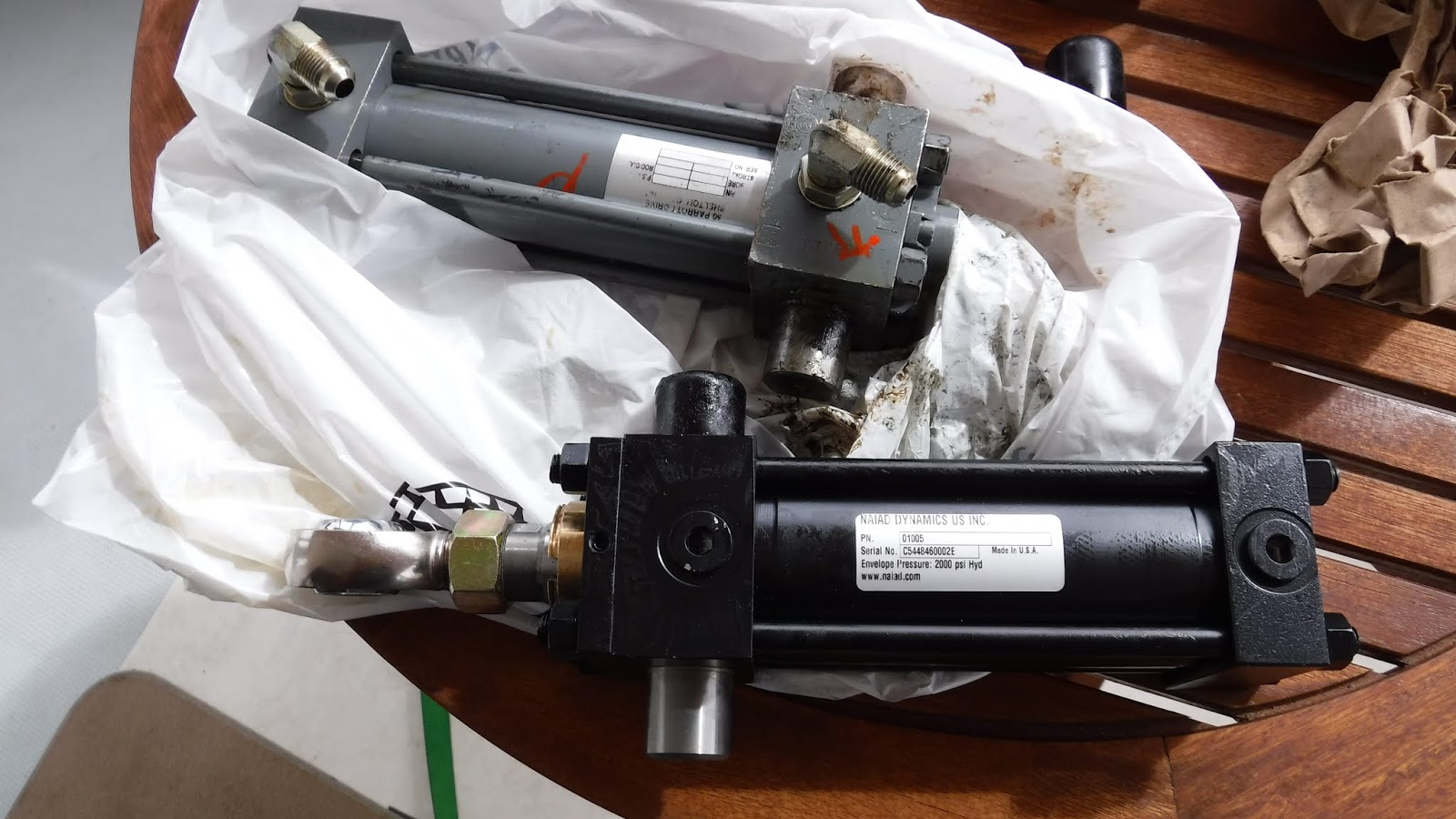
Recall that while approaching San Francisco we hit two logs
one of which caused considerable damage to our port stabilizer fin. We had gotten new hydraulic cylinders and a
new hydraulic pump in Dana Point and installed them so the system was back and
operational. While we worked on it there
we noted that there was grease coming out of the top seal on both fins which
could be a sign that the lower seals were failing or that the grease had come
through the seal two years ago after we replaced the bearings and we had never
noticed it as there are covers over the top of the mechanisms. We decided not to panic but to be prepared so
we ordered new seals and a used main casting and a used torque arm that we had
delivered to Jerry in San Diego. Our
hope was that once the grease was cleaned up it would not return and we would
store the parts until our next planned haul-out. If the grease did recur then we had the parts
we expected to need in hand and could make repairs wherever we could arrange to
haul the boat. Sorry to say but the
grease reappeared on our way down to Cabo.
The reason for the main casting was that when we sent underwater photos
of the top of the fin to a person very familiar with our type of stabilizers
after the collision he mentioned that it appeared that the casting had been
mounted too low when it was originally installed so it protruded about ¼ inch
into salt water and was likely suffering from corrosion. In retrospect we recalled that when we had
replaced the bearings in 2016 we had done some repair to corrosion damage on
the lower edge and made a mental note to keep an eye on it. Since the log had apparently loosened the
casting it seemed a good time to address both issues at once, the log damage
and the installation issue. The torque
arm had clearly bent about ¼ inch with the collision and I was able to bend it
back only about half of that distance and then had to grind off a bit of the
end of the hydraulic ram to make it fit.
Again it was working as I had it but it seemed prudent to do a full
repair whenever I had everything apart. While we were in Cabo San Lucas we
started calling yards as far north as La Paz to try to get a plan for hauling
the boat. We ended up deciding to use a
yard in San Jose Del Cabo.
 |
| From the church, marina on the left, boat yard is the large building to the right, town is in the distance |
 |
| From "Container Restaurant" (its build from shipping containers) |
 |
| One of many sculptures around the marina is this massive cross that lights up at night |
San Jose Del Cabo may only be a few miles north of Cabo San
Lucas but it is as different as night and day when it comes to being quiet and
relaxing.
The marina is about a mile
from town which is much less resort and much more local in nature.
The boat yard was not inexpensive as we had
been led to expect – apparently folks from southern California are used to very
expensive boat yards and consider the Los Cabos yards to be a good deal but we
are from Puget Sound and points north where yard rates are much cheaper.
That said; the yard itself was very clean and
had excellent equipment and staff eager to help.
They agreed that we could work on our own
boat and arranged for us to stay on it by providing us with an access key. (The
marina allowed us to keep our keycard
The manager was telling me his background and it turns out that he used
to manage the Bayliner plant in Arlington only a few miles from where we raised
our children while he lived in Mill Creek near where our final terrestrial
house is located – talk about a small world.
We worked our fannies off in the Mexican heat so we would be sure to
find any surprises with enough time to correct them and not extend our yard
time beyond what we had budgeted.
As it
turned out there were no major unexpected findings and we were able to enjoy our
final day in the yard as it was a Sunday and no one was around to launch the
boat anyway.
The old casting was not as
hard to remove as I had feared once I bought a “gato” at Walmart (it turns out
gato translates to both “cat” and “car jack”).
The bearings showed no signs of water damage (we didn’t have bearings
with us so if they had needed replacement they would have had to come from San
Diego) which was a relief.
We did make a
HUGE mess when we emptied the motor oil that the hydraulic system uses as a
fluid and pulled out all of the 20 year old hoses as we decided to address
another hose project while we had the system apart anyway.
When we returned the boat to the water on
Monday we had to do some minor corrections but we were able to head north the
next morning.
Getting hydraulic hose demonstrates some of the challenges
of working in a foreign culture. One of
the yard folk took the hydraulic hoses to a local hydraulic store as soon as we
pulled the boat out of the water (we had pulled the hoses the evening and
morning before being lifted). The next day we were told the new hoses would be
ready at shortly after noon and that the yard could provide a translator /
driver to get us to the shop where the hoses were being made. The plan was that we would pay directly for
the hoses so that the yard would not need to add a markup for running the costs
through their accounting system. When we
arrived at the hydraulic shop I confirmed that they could take a credit
card. As we stood around I realized that
the hoses were not quite finished as they had apparently needed some additional
fittings (likely from 2 different sources).
We find this to be common in that small operations cannot afford to
stock as much as we are used to so they will accept the order and then have an
employee run to another location to pick up supplies (e.g. I’ve ordered orange
Fanta pop a couple of times and rather than saying it’s not in stock, an
employee zips out the door to the grocery store down the block to buy a single
can.) When we tried to run my credit card it wouldn’t go through. I called my credit card company and they
indicated that the charge request had never reached their computers but assured
me they would accept the charge when it did.
To make a very long story short, it turned out that the bill was for $Mx
32000 pesos (about $US 1500) but the shop didn’t normally get orders that large
so the bank had only set their credit card system to accept charges up to $Mx
5000 pesos. Our next step was to go to
the bank and try the cash machines but they only could dispense $Mx 6000 pesos. Even the bank manager couldn’t help with a
solution (and the teller line looked like it was a DMV office). In the end we gave up and asked the yard to
cover the bill and we would pay a premium for their service.
Monday morning we broke a few rules and paid for it. We
generally try to watch weather forecasts for a few weeks in a new cruising area
so we can get a picture in our minds of what happens when.
We knew that there was wind expected from the
north at 10 -15 knots but we didn’t know what that meant on these waters nor
did we know how accurate forecasts are or aren’t in this area.
We also usually try to leave pretty early in
the morning so we get going before daily winds pick up in the afternoon, on
this day we figured we only had a 4 -5 hour run so no need to rush.
We generally have a rule that if our “gut”
says something isn’t right then we need to consider why we are feeling that way
– I felt rushed and noticed that a number of other boaters chose to stay in
port rather than head out.
We have
always heard that when you cruise on a schedule you are asking for trouble and
we chose to leave primarily to save paying another day’s moorage fee in the
marina. Finally before we head out we walk and crawl around the boat to make
sure everything is ready for the sea, since the water was calm when we headed
out we ignored this step.
About an hour
into the trip the wind picked up off our bow to 17 -20 knots.
Rather than have gentle swell of 2 meters we
had short period wind waves of 2 meters making the boat slam up and down from
bow to stern – did I mention we didn’t set up the paravanes that are our defense
against this kind of motion despite our practice of always doing so when we
head into open water?
So we are bumping
along and just enduring the trip when Clarice checks down below in our berth
and finds a porthole that wasn’t battened closed.
Salt water is gushing in with each wave onto
our bedroom settee and onto our printer/scanner and DVD player which toasted
their electronics.
All we can say was
that the anchorage in Bahia Failes was well protected and the beaches lovely
and the snorkeling great and the friends who visited were great company so
after a couple of days and nights it was all worth it.
Some parting shots of wildlife at sea including one of about 50 turtles that were resting on the surface in one area and dolphins jumping way out of the water. We have not yet been able to catch a photo of rays doing up to 3 head over tail flips out of the water or the schools of fish that visit the boat at night.
 |
| Snorkeling |
 |
| Snorkeling |
 |
| I just get a kick out of pelicans |
 |
| One of about 50 turtles we saw in one area |