What's in her name?

What's in her name (Salish Aire)?

Salish
from her new home the Salish Sea

Aire as in a melody of song.

Salish + Aire = The melody of the Salish Sea.

Salish Sea:
In the late 1700's Captain George Vancouver wandered around the waters of what are now known as British Columbia, Canada and Washington State, USA. He did the usual 1700's explorer thing and put names he chose on everything he saw. The names stuck and are recognized and used to this day.

New lines were added to Captain Vancouver's charts in 1872 (after a near war with Great Britain over a pig) which made waters on one side of the line Canadian and those on the other side of the line American.

It wasn't until 1988 (officiated in 2009) that someone finally realized that fish and various critters, (to say nothing of the water itself) were never involved in the boundary treaties and really ignored them completely. (This is best illustrated by the problems that Homeland Security has with Canadian Canada Geese and American Canadian Geese - it seems they refuse to carry passports and have been known to poop on the head of any border patrol person who tries to challenge their right to cross the border when and where they choose!) In reality the waters from Olympia to the well up the East side of Vancouver Island are pretty much one ecosystem.

The Coast Salish are the indigenous peoples who live in southwest British Columbia and northwest Washington state along the Salish Sea and share a common linguistic and cultural origin. The Salish Sea is named in honor of the earliest recorded peoples who plied her waters and learned to live in harmony with her.


Thursday, August 17, 2017

North of Queen Charlotte Sound


8-16-17

At one time I believed Alert Bay was just a Canadian Coast Guard Radio outpost as we heard them calling the further north we travelled.  When we came up this way in 2000 we learned that Alert Bay has a very large First Nations presence and an outstanding cultural center.  I really wanted to stop in again to visit the cultural center and it was as good as I recall (but no photos of the displays are allowed and it is the Potlach Room full of historic dance masks that awakens something deep in my soul).

First Clarice made a fancy breakfast

Alert Bay Marina
Anglican Church Alert Bay

This time the Coast Guard Station has been reduced to an automatic repeater station for Victoria Coast Guard and we ended up at a grill owned by an Indian (NOT First Nations) family who served me really great halibut and chips and Clarice a tandoori chicken dish native to India. 
Sunday morning Clarice served a very fancy breakfast then we attended the Anglican Church in town before walking to the cultural center.

The next night we spent in Hardy Bay where we double checked the weather for the morning and all looked good for an early departure to cross Queen Charlotte Sound which is one of the two places we have no choice but to be exposed to the Pacific Ocean on this route north.

Sunrise leaving Port Hardy

Sun rises above the low clouds (Canadian CG ship)

Lots of little islets as we head out Queen Charlotte Strait

Rounding Cape Caution
Jarvis hunkered down by his heat outlet while we are on less than smooth water 


We had a very nice crossing of Queen Charlotte Sound with about 1 meter swells and about 5 kn winds usually off our stern.  During the crossing we had porpoises in our bow wake for a bit which was very entertaining to watch.  Overall it made for a long day but there was lots to see along the way. Our current sea mammal viewings include a humpback whale, a very large sea otter (that we thought was a log and almost ran over), lots of seals and sea lions, and periodically porpoises at a distance and now up-close.

In many ways this is our first long distance shakedown cruise after doing 3 years of upgrades and learning about the boat. In the last update I noted that I had finally buckled down and was trying to understand all of the nuances of our 12 v system and the measuring gauges that came with the boat.  My timing was serendipitous as I had just learned that I did have a way to watch the amperage output of the main engine alternator. I had been just using voltage changes as an indication that it was working correctly which really indicates a problem after it has been going on for some time.  Several times in the past few days we have noticed the alternator output drop to very low or zero.  The first time it happened I confirmed that no connectors had fallen loose, belts were tight, and other usual alternator trouble shooting.  We shut down the engine and restarted and had good power output so we figured that something had been loose.  The next time it happened I learned that if I disconnected then reconnected the external voltage regulator that it would reboot and we would have power again for a while but this strongly hinted that the external voltage regulator was the source of the problem.
Batteries on boats are one of those topics that can lead to long strings of absolutely correct opinions that all disagree in some way in boating interest groups.  In summary; it is generally agreed that flooded batteries, such as we have, should be charged in 3 stages.  Stage one (the “bulk” phase) is to get a lot of power back into the cells quickly and runs at about 14 volts.  Stage two (the “absorption” phase) is at a lower voltage and “tops off” the cells.  Finally Stage three (the “float” stage) maintains the voltage during light use and/or storage.   Fancy regulators are designed to maintain the batteries for the longest service life possible by running them through a very carefully prescribed charging process.  Many boats are equipped with external regulators that direct the charging process and are considered by many as superior to the internal regulators that are used on alternators in cars and trucks throughout the world.  Since we carry a matching brand new spare alternator which came with an internal regulator it seemed a good plan to either swap out the regulator or the entire alternator.  Swapping the brushes and the internal regulator from the new alternator was a pretty minor process compared to swapping the entire alternator so I decided to give it a try.  As we have carefully planned, but never had to put into practice before, Clarice started the wing engine (which started on the first revolution after all of our work on it!) and then shut down the main engine while communicating with me via a Bluetooth headset that I have adapted from my motorcycle helmet to fit in hearing protectors.  The swap went smoothly and the alternator immediately started producing power and continues to do so today.  Now the question remains is there a correction that I can make to the old external regulator or has it reached the end of its service life. Also will the new regulator work “just fine” or is it really worth the trouble to go back to an external device.

Installing a new alternator regulator underway


I also spend the morning yesterday while we were at anchor moving a bunch of connections in the pilot house and in the front battery bank area so that the gauges themselves are wired to better function with the changes that have been made since they were installed a number of years ago.  We now have good and reliable data on the alternator performance, status of the main engine starting battery and the forward house battery bank.  I still need to move some heavy wiring in the aft bank (which we tend to use as our backup bank) before I will have good data but at least I now understand the changes that need to be made.

After crossing Queen Charlotte Sound we anchored in Pruth Bay around the corner from the Hakai Beach Institute.  Not only is Pruth Bay a very protected and lovely place to anchor the folks at Hakai welcome visitors with a dingy dock, limited internet access, and boardwalk trails to several of the prettiest beaches we have encountered north of the Oregon Coast.  The difference between the beaches on Calvert Island and the Oregon beaches being that the crescent white sand beaches with picturesque rocks and islets off shore are places of solitude rather than covered with hordes of tourists.  The grounds of the Hakai Institute are also lovely with natural vegetation mixed with floral gardens.
West Beach Calvert Island

Clarice on West beach Calvert Island


Happy Jarvis 1
Happy Jarvis 2


White sand and rock on West Beach Calvert Island

Nature's sculpture

Shallow lake along the trail from West Beach to North Beach

North Beach

Selfie on North Beach

Clarice pulling the crab pot


We ended up staying two nights and taking Jarvis to the beaches a couple of times where we walked and enjoyed the scenery while he ran around being a picture of pure, unadulterated doggy joy.   Clarice was even able to stock the refrigerator with some crab meat for a future meal.
Today we are heading north towards the almost ghost city of Ocean Falls.

Jarvis and Clarice playing on the beach video

8/17/17

On arrival in Ocean Falls we quickly pulled down a ceiling panel as we had a small drip when it rained.  Turns out that a bolt holding the radar base was leaking.  We did a quick seal job and made a note that in the future we need to pull the whole base and re-seal the whole thing as one bolt leaking is suggestive that time has taken its toll and the other 7 bolts will drip before long.


We left Ocean Falls early this morning.  I have always had an interest in wilderness towns that have lost their reason to exist and are going back to nature.  Ocean Falls was created to support a paper mill which was built as the source of the paper’s raw material.  Forest were plentiful and power was cheap once a dam was built at the head of a falls near the apex of an inlet. Several huge concrete buildings were put in place for the mill itself and workers housing.  Initially the paper company decided they could no longer make a profit and so stated its intention to leave.  British Columbia bought the mill and tried to keep the workers employed but the mill could not make it even as a non-profit and so it was abandoned.

Approaching Ocean Falls - The tall concrete building is long abandoned

The dam designed to power a paper mill and town now needs to make only a fraction of its design electricty


The lake above the dam

At this time the dam still exists and makes power for Ocean Falls and two other towns.  A marina is maintained by the small cadre of full and part time residents for themselves and visiting boats.  There are just enough folks living on –site to justify a BC ferry run a couple of times a week with a tiny ferry boat.   A company that raises Atlantic salmon smolt  for the fish farm industry has taken over the old paper mill and provides a bit of employment.  Most of the original town is falling into ruins accelerated by the huge annual rainfall. I enjoyed walking about but was ready to leave this morning as we need to get north a ways if we are to make the weather window we hope will open next Sunday for Dixon Inlet.

We have arrived in Klemtu First Nations Village after a bumpy ride through Milbanke Sound with winds gusting to 24 knots. Our route from Ocean Falls took us through Gunboat Passage with some really nice scenery.  Exiting Milbanke Sound we encountered fog in Fitz Hugh Sound where we had some pleasant radio chats with a BC ferry and a small freight boat to make sure everyone knew what everyone else was doing with about 1/2 mile visibility.  AIS ("see and be seen" for boats) is really nice when visibility is limited. It doesn't replace radar but it certainly adds to it. From the fog we moved into lower winds (gusting to 14 knots) and its raining very hard so its nice to hunker down in our warm boat.  Clarice made soup and toasted crab and cheese sandwiches to warm us up after a walk into town.

Eagles adorning the entrance marker to Gunboat Channel


A tug and two barges headed to Seattle


Saturday, August 12, 2017

Salish Aire has left the Salish Sea

8/10/17

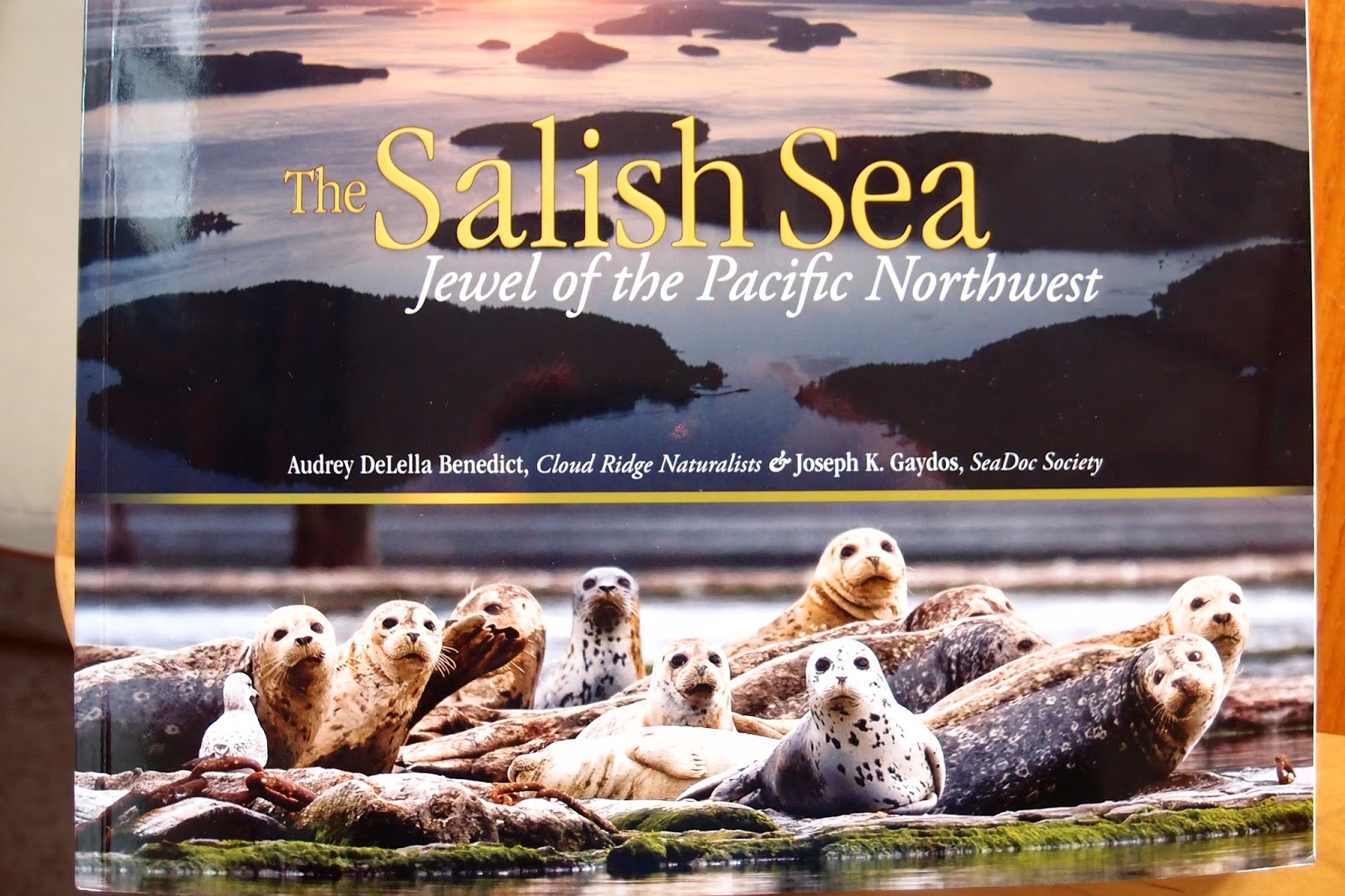
By definition the Salish Sea includes the inland waters of Washington and British Columbia that are primarily connected to the Pacific Ocean tidal circulation via the Strait of Juan de Fuca.  We have now travelled north of that general boundary and the currents and tides of the waters we float on communicate with the Pacific Ocean via Queen Charlotte Strait.  Salish Aire was named to carry the legacy of her home port wherever she travels and now she has officially started on that journey.  While we were walking around Sidney BC we poked our heads into the local aquarium and found a great book explaining the Salish Sea which we bought to show folks we meet during our travels about this fascinating area.

A great book telling the story of the Salish Sea

Map of the Salish Sea

We have heard many many questions about our specific plans for our travels.  We are purposefully keeping those plans to a minimum.  In doing our book learning in preparation for this journey one message has been repeated over and over by experienced cruisers which is that over-planning and over-scheduling is the fastest way known to get yourself into trouble.  Experienced cruisers study the weather carefully and let nature determine when they will leave port rather than letting a date on the calendar make those choices.  In our case, we have a lot to learn about handling the boat and our own capabilities.  We know that the boat will cross an ocean but we doubt our own readiness at this point. 
The plans we have made are to head north to SE Alaska with the plan of staying over in a port (likely Sitka) for the winter. We had hoped to meet up with friends from Everett as they headed south from their summer expedition to Glacier bay and we were able to meet them 2 days ago in the Octopus Islands where we are currently anchored.  We had also planned to move fairly quickly north until we were north of the common “Desolation Sound” cruising area which has its northern psychological boundary about where we are now.  From here north we have only visited once before in 2000 and have looked forward to taking time to enjoy at a slower pace.

Likely one of the big reasons that the boats from the Salish Sea tend to start thinning out from here north is that the tidal challenges become significant.  One of the challenges of boating in this part of the world is learning to live with nature’s tidal exchanges which in some areas create rapids that have put many a boat on the rocks through the ages.  Now we have the advantage of very carefully studied and calculated tidal guide books that tell us when the twice daily rise and fall of the tides changes direction and thus creates windows when the waters in the narrow spots are quiet and safe to transit. We have spent our entire boating careers living with these facts of Salish Sea boating life so while we find the challenges to be inconvenient at times we just follow the rules set by the sun and the moon and recognize that a big part of the diversity of life in these waters only exists because of the mixing of waters providing the nutrients to drive a complex food chain.  Boaters from around the world tend to think highly of boaters from this part of the world because of our comfort with the moving waters and even local boaters shy away from the fastest rapids which leads to less crowded boating the further north we travel.

Tug and log boom working the tidal currents


So far we have transited tidal rapids in Deception Pass Washington, Dodd Narrows BC just south of Nanaimo, and Surge Narrows so that we could get to our present location in the Octopus Islands. After having a wonderful day yesterday visiting with our friends and Kayaking and Hiking to a mid-island lake we plan to leave today when nature says it is OK.  Today we plan to move north and east so we can go the “back route” and avoid Seymour Narrows but in order to do so we have to travel through a  number of challenging tidal rapid areas.  Our first encounter will be with the rapids at both ends of Hole in the Wall channel and then we will turn north toward the Yaculta rapids group.  So far it looks like we will need to wait the six hours between slack times in order to make it to our planned anchorage for tonight as the timing of slack waters doesn’t allow for travel from one narrows to the next at our speed.

Eric and Michelle on Secret Beach headed south after a summer going up the Inside Passage 
A hazy sunrise thanks to forest fire smoke


Octopus Islands Anchorage

Heading out of the Octopus Islands


8/12/17
We are currently in Johnstone Strait which can be a really nasty piece of water if the tide is against the wind or a very pleasant place to travel as it is this morning.  We were able to get through the final 3 tidal rapids yesterday after managing to creep through the Yaculta group at 3.5 knots over ground (while doing about 9 knots over the moving water) just after slack but before the full fury of the rapids had built the day before. All of this moving water has meant that our expected 3 nm / gallon of fuel has instead been just over 1 nm / gallon as it seems that we keep moving up current – until today when we are finally in-sync with the tide as it ebbs north instead of south during the first half of the day. We are currently moving at 8 kn over ground and 6.9 kn over water so nature is giving us a “free” extra mile every hour.  We started the day on mirror smooth water but in thick fog. As we have moved from the side channels into Johnstone Strait proper the fog lifted a bit so we didn’t have to be totally dependent on radar an AIS (location information broadcast by some, but not all boats).  As we have moved north the fog bank has kept ahead of us so we have had good visibility most of the day.
Speaking of visibility, we seem to finally have moved north of the smoke from the BC forest fires.  Last night Jarvis decided he needed to visit his pee-poop pad at 2 AM but it did mean that I was awake to see the moon and the stars for the first time without a haze of smoke. 

In the heavy fog we could see our own bow and not much more

Both radar units and the AIS transmissions from other boats become our "eyes"
and we listen carefully for horns or engine noise

The fog begins to lift just a bit
Finally able to see ships visibly we had been watching electronically


Chasing fog up Johnstone Strait


Fog off the bow but clear looking south down Johnstone Strait


Folks often ask if we are tied up every night or anchored – the answer is we do both.  As we are trying to learn to live on a much more limited budget we are taking advantage of low cost opportunities to be at docks when they are available as it makes it much easier to get to shore otherwise we anchor out which has the advantage of (usually) being very peaceful and private.  Low cost dock opportunities so far have included using yacht club reciprocal moorage (usually about $5/night for power), using public / commercial wharfs (about $40 USD / night in Comox), and a complimentary night as we chose to use the unmaintained outer dock at Morgan’s Resort (which was only a couple of hundred yards from the VERY expensive docks at Dent Resort (reported to be $4/ft so about $200/night for a boat our size and with the expectation that you get dinner at $125/plate!)
The weather has cooperated being in the upper 70’s during the days and just cool enough at night for Clarice to sleep well with the overhead hatch open.

Our very inexpensive moorage looking at the transoms of Dent Resort

Entertainment consists of watching the scenery, walking on trails through the forests (which lets Jarvis’ inner Jack Russell come out as he runs full speed up the trail to find the next “nose candy” and then sniffs for a bit before taking off again), swimming in a lake, checking out a harbor’s nooks and crannies in either the dingy or paddling in kayaks,  reading books, watching the British TV series “Last Tango in Halifax”, catching up on business and pleasure email when we have cellular service, and doing boat maintenance.  Boat maintenance ranges from the basics of checking the engine room periodically for any signs of trouble to rebuilding another section of the pilot house panels, to learning how our electrical gauge system is designed to work (and how I need to change it so it works with the current battery and solar configuration).  All in all Clarice and I keep fairly busy between driving the boat (which can be anything from very intensive in a high current area or high traffic area to really boring when the auto-pilot is keeping us on course without much human help required and all stages in between).

Making blackberry cheesecakes for desert

Drying laundry

New facings for the radar and SSB radio - Old gray Formica under the chart plotter

Next area to be refaced with holes from retired gauges
(ladder, plug and key chain to the left get hung in front of chart plotter as reminders
that our ladder is in the water and shore power connected.) 

So far we have happened into a festival and fireworks show in Comox, met up with our good friends Eric and Michelle as they headed south from Alaska, had a quick radio conversation with some Nordhavn friends as they headed south through Dent Rapids and we headed north, had a pleasant visit with some other Nordhavn friends while we waited at Shoal Bay Resort for the slack to occur for our next rapids transit, in addition to people we just meet on the way who have a common interest in boats and nature.  We have heard over and over from long term cruisers that you are never out of touch with friends for too long as you will often run into someone you know at the next port.  We are certainly finding this to be true.

Our friend David passed us in Mary Pearl just as we were about to go to press

As far as adapting goes, we are now 1 week into official retirement.  To say that we haven’t felt a bit of stress would be untruthful.  A couple of days ago Clarice and I found ourselves grouching with each other over things that normally we just let go.  We took a minute and reflected on all of the changes and stressors over the past month as we had the kids visiting, and were finalizing employment, and mail, and insurance, etc. issues on top of moving to a whole new lifestyle and agreed that while being grouchy was not fun it was to be expected.

I hope to post this today as we plan to stay in port at Alert Bay where I have really nice memories of a First Nations museum from our last visit in 2000. We had planned to spend time in the Broughton Islands but it looks like we have a nice weather window for crossing Queen Charlotte Sound if we keep moving north so our plans have been adjusted accordingly.


Friday, August 4, 2017

A baby step starts the “Grand Adventure”


July 30th Clarice and I both were a bit restless as we settled in for bed.  We were both thinking about our lease running out the next day and the requirement that we move Salish Aire by noon.  When we started living aboard I assumed that a boat slip was a boat slip was a boat slip and that moving from one to another was no big deal.  After all wasn’t that one of the adventures of this nomadic lifestyle? But we have come to realize that our slip has become our home as we know our neighbors and who walks by when so we are ready with complimentary greetings and smiles. Jarvis knows which footsteps deserve a gentle “woof” as they are a known neighbor, who will pet him on the head if he runs out, and who is unfamiliar and needs a major “bark-bark” (and much the same for dogs walking by – are they a friend, an “unfriendly”, or an “unsniffed”.) In the end a friend a couple of slips down contacted folks from his yacht club who were away for the coming week and was able to secure us a slip a short 75 feet away (but on a completely different dock group and thus a new “neighborhood”).  And so our Grand Adventure has started out with a move away from our home neighborhood, but like the child that goes to live in a dorm in the same town, we aren’t too far away and our friends still wave across the fairway and run over to check on last minute details.

Since the last post a number of major events have occurred as we get ready to truly cast off.  Clarice officially retired on July 14 (she is now the first “pensioner” as we like to say after watching the British Series, Last Tango in Halifax), we have spent a couple of weeks getting our retirement funds moved to a central broker, we have been completing some known boat projects and attacking a project that we had hoped to put off until it declared it didn’t like being ignored, and most importantly visiting with our daughter’s family as they joined us for their annual summer visit. So our plan is to leave Everett in two days when I also become a pensioner after we have had a couple of days to rearrange the boat from three weeks of  6-7 people living aboard.

Our daughter’s children have previously declared that the prime motivation for coming to visit us is that they can stay on the boat, so while it gets a bit cozy, we all stay on-board while they are here. Some notable quotes from this visit:

V (7 y/o granddaughter): (After I explained that Jarvis sees me as the alpha of his pack) “Oh, so Jarvis is the Omega.”

H (8 y/o grandson): “I don’t want my [loose] teeth to fall out before we get to the United States [from home in Canada] so I get a better exchange rate on my tooth fairy money!”

C (12 y/o grandson): Lots of puns and very happy to get a tin cup that says “Camping is InTentsive”.

V sleeps soundly in the Pilot House berth

H is happy on an air mattress on the floor

V has "moved in" to "her space"

V and H "Bow Surfing" 
V turned 7 while she was here


Kids found a pop-up book in a tiny library in Anacortes
Jetty Island water fun

Jetty Island mud fun

We start them early

Clarice checking C's tolerance to motion sickness


The kids flew back home on August 2nd after dropping our final motor car off at SeaTac airport where our daughter-in-law took possession as we had previously arranged.  Even though they had been in a cramped boat for 3 weeks the kids were all sorry to leave as they really enjoy visiting family, visiting friends, playing on the beach, playing with Jarvis, and just being on Salish Aire.

Today is August 4, 2017 and it is my (Norman) last official day before retiring (I’m taking a vacation day).  We left Everett about 6:30 this morning and are now steaming north on very smooth seas with warm (expected to be hot) weather, and very heavy haze from forest fires in BC Canada and about 30 miles east of us. We plan to spend tonight in the San Juan Islands after catching the 3 PM slack through Deception Pass and then enter Canada on Saturday the 5th where we will top off on fresh foods we can’t take across the border.

Red sunset from forest fire smoke

It seems to be a common theme among boating folks getting ready for a longer passage that they get ready over a long time (in our case, 3 years) but then find a whole pile of last minute things to finish up. Here is our list 
:
Bow thruster motor:  It had failed about two years ago when a solenoid’s contacts carboned up.  I took it apart and filed the points and it has been happy since until last weekend when it failed again and refiling made the contacts too short to function.  We have also had the motor hot enough to smell in the pilot house at least once so we have wondered for some time if it was going to hang in there. Salish Aire was built in Taiwan and, I have always assumed, fitted out in Southern California but she has a lot of local parts on her.  One of the parts is the bow thruster which was manufactured about 10 miles from Everett.  Recognizing the need to do a final repair and the convenience of being able to drive to the factory for parts (which they had on the shelf) we went ahead and put out “a boat unit” and bought a new thruster motor which included a pair of new solenoids.  I had planned to take the old motor into the factory to confirm it matched but I was having problems getting it loose from its base so I took photos instead which turned out to be a good thing.  The Wesmar factory guy took a look at the photos and let me know that I had a very non-standard installation and explained what a standard installation would look like. When I got back to the boat I found that he was correct that we had two stacked adapter collars on ours when one is standard.  On trying to install the new motor with the old coupler I realized that the old coupler was too long (it also was held from sliding by hose clamps on the motor shaft).  The next day I went back to the factory (so very nice it is close!!) and picked up a new coupler (which they machined to fit the older installation while I waited) and we recognized that the original had been extended by welding an extra length of metal onto it. I am guessing that the original coupler kept moving on the shaft and so at some point an attempt was made to correct this issue.  It looks to me like Wesmar has since addressed this problem by adding a second set screw so I don’t expect further problems now that the thruster motor is back to a standard installation (and I have a few more spare parts to store “just-in-case”).


There is typically only one adapter (black band) here instead of 2 stacked 
Old thruster motor being readied for removal 


hose clamps had been added at some point to the shaft to keep the coupler in place


Pilot house woodwork: Salish Aire’s pilot house has had 20 years of adding and taking away of gauges, controls, etc from her pilot house and the woodwork shows it with many patches and holes.  I recently learned that a local place wholesales teak plywood and that they will sell retail so I went and bought a sheet of 3/8 plywood and a sheet of thin veneer to use to bring her back to her stately self. The purchase was made a week prior to the kids arrival and I was able to rough in the overhead dashboard but that was about it.  The rest of the materials were cut down to sizes that could be stored and they currently are laid on the top bunk in the spare berth room. The grandkids love to sleep in the pilot house so I didn’t want to varnish until they were gone so yesterday I finished the woodwork just in time for our departure.

This is the beginning of the dash replacement project (previously it was gray Formica with a lot of patches)


Scrubbing and buffing: There is no way that Clarice is going to leave the dock on a less-than-shiny boat so she has been working over the past month to get everything washed and waxed.
Provisioning: We have been slowly gathering food and material staples for some time but stocking a kitchen for 7 persons (including 3 youngsters) is very different that having the galley ready for the two of us and Jarvis so final runs were made the past 2 days.

Clarice waxing

Clarice removing the last of the scum line


A new dingy: We had planned all along to continue using the Carib dingy that came with Salish Aire but our resolve started to weaken when we lifted one of the newer aluminum hull boats and realized we could have a longer boat and it would be easier to heft up a beach. When I was really paying attention to the Carib (I had to replace a patch I had placed on it in 2014 from dropping a drill while I was up the mast) I noticed that the fabric was really showing some age.  I had always assumed it was about 10 years old with a 10 – 15 year life expectancy.  Out of curiosity I read the dingy documents and realized it was more like 20 years old.  Long story short we ended up buying a new dingy last week (we haven’t even had a chance to really test it yet as we have been so busy with Grandkids and preparations).

Provisioning: We have been slowly gathering food and material staples for some time but stocking a kitchen for 7 persons (including 3 youngsters) is very different that having the galley ready for the two of us and Jarvis so final runs were made the past 2 days. 

Vacuum packing the brand of dog food that agrees with Jarvis' GI tract

Plenty of coffee beans for Norman

Easily stored dried fruit

A seat full of canned goods

The shaft packing:  Salish Aire uses a traditional shaft packing to keep water from entering around her propeller shaft.  This system has been in use for hundreds of years and involves putting rope around the shaft and tightening a fitting that squeezes the rope until it seals the shaft – almost.  The rope would quickly overheat and potentially damage the (VERY expensive!) propeller shaft except that the wise old shipwrights figured that if you let a slow drip of seawater lubricate the rope it would keep it both lubricated and cool.  We try to set our seal so it drips several drops a minute at rest.  Last week Clarice noticed that the drip rate had increased enough to cause the bilge pump to cycle fairly frequently and so we readjusted it. Mind you that adjusting the seals is a very inexact process and involves turning some nuts and then listening, then making the shaft turn and checking again.  Last evening we decided it was now dripping to slowly after sitting for a week – so after pondering the whole shaft seal thing for 3 years we ended up readjusting it the night before we started our long trip.  The good news is that thermometer checks are showing a cool shaft so we think we got it right.

Today we declared our intentions for all to see by flying our Inside Passage flag given to us (and designed and sold by our friend John Gray.


So the Bon Voyage Parties, Happy Retirement Parties, goodbyes to friends and family, and Blessings are done and we are finally on our way.  


A final blessing for our adventure at Trinity Episcopal Church

A final family gathering at my mother's apartment

Mom is making the best of our leaving but would rather we be close 
My sister Margie, brother Timothy, and Myself (sadly I missed seeing our brother Alan when he was up the prior weekend)
Clarice letting me know that all lines are clear and she is aboard
Backing out of Everett Marina for the last time in the foreseeable future


Friday, June 23, 2017

Loss of another parent

Clarice and I have (had) 3 surviving parents; my mother at 90 years old, Clarice's dad at 89 years old both with failing hearts, and Clarice's mother at 83 years old who still tended her 1/4 acre garden (down from about 2 acres when we met) and polka danced through last summer. We have planned our travels with full recognition that we might well need to fly home at some point to tend to a dying parent, most likely my mother or Clarice's dad.

Clarice's parents: Salome and Kelly Chambers
Last summer Salome (pronounced "Sah-loh-me"), Clarice's mother, made comments, as she has for a number of years that it would be her last garden and she probably wouldn't do as much, if any, home canning this year. (For years her 7 children and 14 grandchildren (the 11 great grandchildren are still a bit young) have enjoyed "shopping" when they visit in Salome's fruit room.) Everyone rolled their eyes in unison but this time her prediction  very very sadly came true.

About 2 months ago Salome had some blood tests run which ended up leading to a diagnosis that kept her in the hospital more than she was home. Last Saturday Clarice called her mother and picked up that her speech was slurred so she drove out to their rural home.  When she arrived her mother had all of the classic facial characteristics of a stroke. Tests just indicated that she was terribly ill and the underlying cause was not clear. She was sick enough that she was sent to intensive care.   On Monday (her 63rd wedding anniversary) a specialist was brought in who made a presumptive diagnosis of a fungal infection which generally is rapidly fatal.

Salome was offered the opportunity to be sent to Seattle to a University of Washington associated medical center but declined instead choosing to go home.  We were able to get her on Hospice very quickly and she spent her final four days surrounded by family and friends while Clarice and I put our Hospice Nurse experience to good use.

At this point we feel "all cried out" but I'm sure that the tears will flow again at the funeral two days hence.  My Mother-In-Law could be a challenging woman as she was as strong willed as her daughter but she loved her children and their families with all her heart and we love her with ours.

For all practical purposes Clarice has begun her retirement as she was granted an FMLA leave to help care for her father which extends to her planned retirement date in July.  My manager has been very supportive recognizing that to work as an acute care Hospice nurse one needs to have their own grief under control.

Despite the family crisis we continue to prepare Salish Aire and ourselves for our grand adventure (if nothing else it provides a mind break from the grief).  We've begun final testing of systems including the watermaker (which blew the top off a pre-filter under our bed (the good news was it was fresh water and everything under the bed is wrapped to prevent moisture damage) and the bilge pump system which failed to alarm for high water and wouldn't self prime.

The watermaker parts are expected to arrive tomorrow and hopefully the installation will go smoothly (which would be a first!).  What happened was that we have a practice of flushing the system with fresh water every two weeks to keep the reverse osmosis membranes moist.  We had turned the boat around in her slip so we could do so cleaning work on the side that is usually away from the dock.  Since we use shore water while we are tied up to pressurize our drinking water system and since our normal hose dedicated for this use wouldn't reach with the boat turned around, Clarice hooked up our longer hose instead.  She forgot that the longer hose didn't have a pressure reducer at the dock faucet and so the boat water system was at about 60 psi rather than 40 - 50 psi and the fairly old pre-filter housing couldn't take the extra load.  All we can say is that we are glad it happened before we left rather than underway where we wouldn't have access to new parts.

The bilge pump system issues came to light during a roughly semi-annual wet test where we fill the bilge on purpose to make sure everything is working.  The sequence should be 1) primary bilge pump activates with about 1 inch of water; 2) high water alarm in the pilot house squeals with about 2 inches of water; 3) a very high volume pump activates at about 9 inches of water (the deep part the of bilge is about 20 inches deep so there is still a lot of room before the engine room starts to flood). The test started well with the primary pump activating and pumping water but there was no alarm. To make a long story short the very nice pump / alarm switch that was installed in 2002 had specific instructions about sealing the wires which weren't followed and moisture gradually backed down the inside of the wires and damage the circuit board.   I spoke to the designer of the switch who told me exactly what to look for and what the problem was. I installed a new switch and made a mental note that this was one more system that I should consider swapping out the hoses for new ones. To confirm that the system was now working as designed I did another wet test.  The switch worked great but the primary pump would not self prime so it was back to the drawing board.  Yesterday I replaced the original soft rubber hose with wire would stiff rubber hose and everything worked perfectly with the final test.  (My best guess is that a section of the original hose that runs under the floor and over the fuel tank is either partially kinked or has softened with age and would collapse when the pump pulled a vacuum - since I couldn't pull it out to look at it, I couldn't make a visual confirmation of the hypothesis).

Next on my list is changing the oil in all engines and transmissions.  Next on Clarice's list is a finishing waxing the boat.  On both our lists is looking at the zincs on the bottom of the boat and replacing any that are too far gone. Clarice is starting final food provisioning and I am nearing the end of spare parts and fluids provisioning.  Jarvis has confirmed that a 50# bag of dog food came aboard and plenty of dog treats.

Our daughter did come out for her grandmothers final days and returned home to Ontario Canada on Monday.  She and her kids will be out for their planned summer visit the final three weeks of July and then we plan to be on our way.

We do have to say that we are really feeling the upcoming change to our lives.  Friends have left for their summer Inside Passage trip and unless we can rendezvous with them we may never catch up with them again. We have already made arrangements to sell our final car to our son after 45 years of continuous car ownership. Planning for our bon voyage open boat party has begun.  Clarice has passed on her duties at our yacht club and our church is aware we will no longer attend after the end of July.  On the other hand I purchased the latest edition of the Waggoner Cruising Guide to the Inside Passage and am absorbing little travel planning details.

The Grand Adventure is getting very very close!